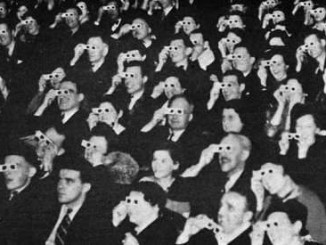
Posted on 28 January 2013 by Rich Drees
Lucasfilm has put a halt to their plans to theatrically release all six Star Wars films visually remastered for 3D.
In a statement, the Disney subsidiary stated that it was cancelling the 3D releases of Star Wars: Episode II – Attack Of The Clones and Star Wars: Episode III – Revenge Of The Sith in order to “focus 100 percent of our efforts on Star Wars: Episode VII in order to ensure the best possible experience for our fans.”
The 3D rerelease of Star Wars: Episode I – The Phantom Menace hit theaters last February and the remaining two prequel films were scheduled for release this coming October and November. The Phantom Menace‘s $43 million box office was only a tenth of what the film pulled in when it was first released in 1999. I would not be surprised if that might have played a part in the decision. In fact, I guessed that something like this could happen back in June 2011 if the box office receipts weren’t up to snuff. (I also wasn’t thrilled that the conversions were being handled by the same production house that did the post-conversion for the Clash Of The Titans remake.)
Although the original Star Wars trilogy was covered in Disney’s original announcement, no release date had been announced for them.
It’s not known how much conversion work has already been done on Episode II and III, though I would suspect that it will be quietly completed, if only so Disney has the conversions ready for an eventual home video release if 3D television manages to take off.
Tags: 3D
Posted on 24 April 2012 by Rich Drees
A study released by the International 3D Society would like you to believe that that people just love the format. But a critical look at the numbers that they are presenting reveal a different story.
According to their survey conducted by the Opinion Research Corporation, 52% of 1,011 Americans 18 years old and older surveyed (or 526) had seen at least one 3D film in the past year. And out of that group 71% reportedly prefer 3D films to 2D ones. Additionally 31% of that 52% stated that seeing 3D films is “incredible.”
But then again, of course a study paid for by an organization calling itself the International 3D Society would have this kind of result. According to the group’s website it is a group “founded to advance the art and technologies of stereoscopic 3D content and its professional innovators.” It doesn’t really get into specifics as to how founded it, but considering that their chairman is Jim Mainard, head of Production Development at Dreamworks Animation and that several members of their Executive Committee and Board of Governors are all highly placed studio and filmmaking technology executives, it is kind of hard to look at them as completely non-partisan.
But let’s break that down a bit. A quick bit of math reveals that out of those 1011 surveyed, only 373 (or 37% of the total surveyed) prefer 3D to 2D with just 163 (16%) people found seeing a 3D movie “incredible.” Not as rosy as their presentation of the facts would lead you to believe.
It is certainly not in keeping with Variety’s headline of “Moviegoers surveyed say 3D pics are better” with which they report this story. But then again, Variety, who basically just ran a rewritten press release, has a vested interest in keeping the industry happy and reporting what they would like to be reported.
I think that what has been said about the inflated numbers that Hollywood usually offers about piracy losses can be applied here as well – Never trust numbers offered by an industry whose main product is fiction.
Posted on 12 March 2012 by William Gatevackes
You’ve got to love AMC Theaters. Much like they do with the Academy Award nominees each year, the theater chain is offering comic book movie fans of great endurance a chance to see all six Marvel films (Iron Man, The Incredible Hulk, Iron Man 2, Thor, Captain America: The First Avenger and The Avengers) on the big screen, one after the other, all on the same day. Well, two days if you count The Avengers being a midnight showing. That day would be May 3rd.
Tickets for the event are on sale at these theaters:
- Boston Common 19, Boston, MA
- Burbank 16, Burbank, CA
- Downtown Disney 12, Anaheim, CA
- Aventura 24, Aventura, FL
- Empire 25, New York, NY
- Garden State 16, Paramus, NJ
- Downtown Disney 24, Lake Buena Vista, FL
- Metreon 16, San Francisco, CA
- Alderwood 16, Lynnwood, WA
- Tysons Corner 16, McLean, VA
You can also buy tickets for The Avengers alone at those theaters, if there are any available. More participating theaters will be announced on March 16. Tickets for the Marathon cost $40 for the whole day, which comes out to an economical $6.67 per film. The film viewing orgy starts at 11:30 am.
Be forewarned! Thor, Captain America: The First Avenger and The Avengers will be shown in 3D, but it appears that you will be able to select from a choice of four commemorative 3D glasses.
For more information, including the expanded list of theaters, visit http://go.amctheatres.com/marvel
Posted on 19 October 2011 by Rich Drees
I find it a bit ironic that on the 149th anniversary of Auguste Lumière* comes word that the three major motion picture camera manufacturers – Panavision, ARRI and Aaton – have all stopped making motion picture film cameras within the past year, switching their efforts to developing digital cameras.
An in-depth article over at Creative Cow (pointed to us by the folks at Bleeding Cool) talks with a number of people on the technical side of the industry about how this came about and makes for some interesting reading on the future of film production.
Basically, the rise of digital cameras has not completely made film cameras obsolete, but we’re getting there. Companies who rent filming equipment are reporting that film camera rentals are down in deference to rentals of digital units. The ease of use and flexibility of digital cameras are big factors in this shift. The cameras are lighter and can be moved easier than their film counterparts. With almost all editing done digitally, a digital camera eliminates the need to scan and convert physical film for use. It is easier to synch two digital cameras for a 3D shoot than it is to do so with film cameras. The list goes on and on.
But let’s not mark this as the death of celluloid quite yet though. Although digital seems to be the increasing choice amongst directors and cinematographers, there are some things that film cameras can do that digital can’t quite recreate yet and I don’t think that we’ll completely abandon using film cameras until they can. Furthermore, with the number of different digital video formats, archivists still prefer celluloid over digital for film preservation purposes so there will still be a call for physical film in the foreseeable future.
Make no mistake though. The technology we use to create, view and preserve our movies is currently in a state of transition and in the very near future could look entirely different from today.
* Who, along with his brother Louis basically invented the movie camera.
Tags: 3D
Posted on 28 September 2011 by Rich Drees
A firestorm is erupting in the film distribution world as Sony Pictures announced yesterday that starting next spring, they will no longer be supplying 3D glasses to distributors for free with their 3D films and that theaters will be responsible for shouldering their cost.
Naturally, this enraged the National Association of theater Owners (NATO), who fired back to day with a press statement condemning the plan, accusing Sony of acting in bad faith by making the decision unilaterally. From NATO’s statement -
Since the onset of the digital 3D revolution in 2005 it has been understood that exhibitors would bear the weight of technological and facility modification costs related to 3D, while distribution took on the cost of 3D glasses. Any changes to that understanding must be undertaken through the mutual agreement of both sides of the business.
Sony, of course, is looking to increase its profit margins in any way it can. Their edict is set to start right at the beginning of the summer blockbuster season when they are releasing two big 3D films – The Amazing Spider-Man and Men In Black III. With glasses costing studios about fifty cents a pair, that can add up to $5 million per every $100 million in box office receipts.
But you have to remember that that box office number is inflated by the $2 to $3 extra that is charged onto 3D movie tickets, revenue that is split between the theater chains and the studios, so it’s not like the studios aren’t getting reimbursed for the expenditure, even if it is indirectly. That makes it hard to believe any cries from Sony over the expense for supplying 3D glasses to theater chains in the current set-up.
If Sony doesn’t back down, come next summer theaters will have to figure out how to handle the new expense. Will the chains just absorb the cost of the glasses themselves or that they will pass the new cost onto ticket buyers? I’m guessing that a further charge for 3D films will further push ticket buyers away from the from the format and towards the 2D versions of releases at an even faster rate than horrible 2D to 3D post-production conversations and poorly made 3D films already have.
Posted on 04 March 2011 by Rich Drees
Look, we all know this was coming sooner or later, so there’s probably really no reason to kick up a fuss now. Lucasfilm and Twentieth Century Fox have announced that their 3D conversion of Star Ware: Episode 1 – The Phantom Menace will be hitting theaters next year on February 10.
A press release state that the “conversion is being done with utmost respect for the source material, and with a keen eye for both technological considerations and artistic intentions.”
Where to begin with that?
Well, after years of fiddling with the original trilogy, to the point where he was making changes that damaged the overall integrity of the film’s plot and character arcs, I find it hard to believe Lucas has any real respect for his own films or artistic intentions.
I also find it difficult to come up with a satisfactory answer as to why we would need to see these films in 3D? One of my most favorite shots in the entire series is from the original Star Wars. It’s the Millennium Falcon flying straight at the camera with a sun flaring behind it. If there was any shot that was custom made for and look awesome in 3D, this would be it and I still don’t want to see it in 3D! The only thing that might be a possible ticket sale for me on this is the morbid curiosity for what other changes Lucas might have made in the film.
Posted on 06 September 2010 by Rich Drees
In conjunction with the British blu-ray release of Robin Hood, director Ridley Scott gave an interview to The Independent, which ended with some details about his upcoming Alien prequels. Some of it is previously known, or at least speculated about, and a few new tidbits about the production.
- The prequel will be two films.
- The films will be shot in 3D, and Scott adopts an air of friendly competitiveness when he states of James Cameron, who shot the Alien sequel Aliens - “Jim’s raised the bar and I’ve got to jump to it… He’s not going to get away with it.”
- Lost co-creator Damon Lindeloff is currently polishing the script for the first prequel.
- The film will be set some 30 years before the original Alien.
- Exploring the origins of the titular alien killers, Scott promises that the prequel films will be ” really tough, really nasty… It’s the dark side of the moon. We are talking about gods and engineers. Engineers of space. And were the aliens designed as a form of biological warfare? Or biology that would go in and clean up a planet?”
While I am excited to see Scott returning to the franchise he created over thirty years ago, I have to admit to be less enthused about his return heralding an exploration of the aliens’ origins. A big part of what made Scott’s original film so powerful was the air of mystery about the alien that was stalking the crew of the Nostromo. We didn’t get a good look at it for a majority of the film, it striking out from the shadows. It was vaguely humanoid, but had a biology terrifyingly different than our own. It was an unknowable force of nature and that is what made it terrifying. Doing away with that mystery robs the alien of much of its power to frighten.
Posted on 06 September 2010 by Rich Drees
Juno and The Wackness co-star Olivia Thirlby has been cast in the recently retitled Dredd, the new adaptation of the British comic series Judge Dredd. Thirlby will be playing Judge Cassandra Anderson, a member of the Psi Division of the future law enforcement organization that Judge Dredd belongs to.
As a rookie Judge, Thirlby’s character will be shadowing Dredd around the crime-ridden streets of Mega City One. Karl Urban is already set to play the stone cold titular Judge of the movie.
Vantage Point helmer Pete Travis is scheduled to have cameras rolling on the $45 million budgeted film in South Africa by the end of the year. The film is slated to be produced in 3D. Currently, the production is in the process of locking down distribution deals at the Toronto Film Festival, so I suspect that we’ll hear more cast and release details shortly.
Posted on 18 May 2010 by Rich Drees
It looks like the fever for 3D films isn’t confined to the boardrooms of Hollywood. Japan’s Toei studios is giving director Kinji Fukasaku’s controversial 2000 film Battle Royale a 3D overhaul.
A dark satire that attacked the Japanese education system and the national drive to succeed at nearly any cost, Battle Royale created a furor upon its initial release to the point where politicians denounced the film on the floor of the Diet, the Japanese equivalent of Congress. With a story about a high school class placed on an island and instructed to kill each other until only one person survived, the film failed to get an initial release in the United States due to concerns over a recent spate of school shootings.
Fukasaku’s son, Kenta Fukasaku, is currently supervising the 2D to 3D conversion in Tokyo with an eye for a November 20th theatrical rerelease in Japan. There is no US distribution in place yet.
I am at a loss as to how this could be anything but a blatant money grab on the part of Toei. Battle Royale is a film that I’ve seen several times now and am a huge admirer of, and I really don’t see any other point to converting the film to 3D. A conversion does not add to the story that Fukasaku was telling or the themes he was exploring. I can only really see this as attempting to cash in on the film’s more exploitable elements. I guess that a conversion would enable the film to get in front of new audiences, but I’m not sure that that is a good enough trade-off.
Via ScreenDaily.
Posted on 27 April 2010 by Rich Drees
The 3D juggernaut continues to roll on, fueled by studio execs with dollar signs in their eyes.
The latest film to be getting the treatment is The Ring 3D, a second sequel to the 2002 English adaptation of the 1998 Japanese film about a cursed video tape that kills anyone who views it within a week. Although I found the original Japanese version a better film than the Naomi Watts-starring Hollywood version, but it managed to thrill audiences to the tune of $129 million at the box office. That kind of money sparked a wave of English-language remakes of Japanese horror films, most of them substandard to their foreign originals. Although its 2005 sequel, The Ring Two, managed to still pull a respectable $76 million in ticket sales, the wave had burnt itself out and no one has really been clamoring too loudly for a third Ring movie in the intervening years.
According to the Hollywood Reporter, the film’s storyline is still being kept secret but will “reinvent the franchise” and be “more teen-centric than the first.” Dream House writer David Loucka has been hired to script the film.
And while audiences may or may not have moved on from the Ring films, technology certainly has. Video tape is disappearing fairly fast from American’s homes as the medium of choice for recording television programs and home movies in favor of DVRs and other digital mediums. I have to wonder if the idea of a cursed video tape will not seem anything but quaint in this upcoming movie.