Tag Archive | "Alfred Hitchcock"

Tags: , , , , , , , , , , , , , , , , , , , , , , , , , , , , , , ,

The 15 Greatest Cameo Film Appearances Of All Time

Posted on 02 October 2012 by Rich Drees

The term “cameo appearance” was coined by producer Michael Todd to describe the number of small roles filled by big name stars in his 1956 film Around The World In 80 Days. But Todd was merely putting a name to something that had been a part of films all the way back to the Silent Era and would continue right to the present day. Here is a chronological look at perhaps the greatest of the hundreds and maybe even thousands of cameo appearances that have been made in the movies.

Elinor Glyn In It (1927) -As described in a two-part Cosmopolitan Magazine serial by Elinor Glyn, “It” is “that quality possessed by some which draws all others with its magnetic force. With ‘It’ you win all men if you are a woman and all women if you are a man. ‘It’ can be a quality of the mind as well as a physical attraction… The possessor of ‘It’ must be absolutely unselfconscious and must have that magnetic ‘sex appeal’ which is irresistible..” When Paramount decided to turn Glyn’s piece into a film, there was only one starlet in their studio they knew they cast in the role of the girl with “It” – Clara Bow. And to help explain the concept of “It” to other characters in the film and the audience, the studio had Glyn appear in the movie herself. Not only that, in one of the first instances of product placement, issues of Cosmopolitan are also seen. Although Bow was a star at the time of its release, the film proved such a sensation that the actress was ever after known as “The ‘It’ Girl.”

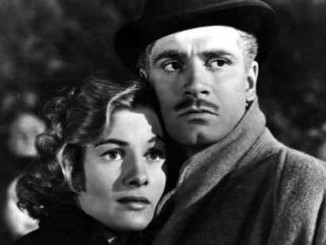
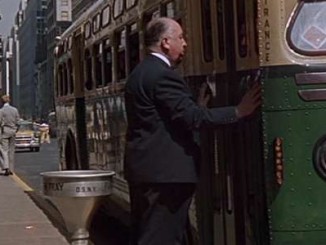
Alfred Hitchcock in Rebecca (1940) – If anyone’s name is synonymous with cameo appearances it would be director Alfred Hitchcock. Hitch knew the value of self-promotion and through his walk on roles in his films and appearances in his films’ trailers he was as easily recognizable as any big star of the time. He made his first on screen appearance in a newsroom scene in 1926′s The Lodger but would only appear sporadically until his move to America. Beginning with his first Hollywood studio film, Rebecca, where he stood behind star George Sanders in a phone booth, Hitchcock would make an appearance in every single one of his films for the rest of his career. Sometimes that would prove to be a tricky proposition, such as for Lifeboat, but it was a savvy move that helped insure that his name became its own brand.

Raymond Chandler in Double Indemnity (1943) – As creator of the detective Philip Marlow, Chandler was one of the shapers of the hardboiled detective genre. It seems only natural that when Chandler began working in films, his first screenplay would help define cinema’s equivalent – the film noir. By all accounts Chandler and Double Indemnity director Billy Wilder never did get along all that well, so it came as a bit of a surprise two years ago when it was realized that the gentleman reading a newspaper whom star Fred MacMurray walks past at an early point in the film is Chandler himself. Given their contentious relationship, it is not surprising that neither Chandler nor Wilder ever mentioned the appearance. It is a shock, though, that Chandler’s obvious cameo went unnoticed and unremarked upon for nearly 67 years until it was finally discovered in 2009.

Jack Benny in It’s In The Bag (1945) – One of the most famous show business feuds from the 1930s and 40s wasn’t really a feud at all, but a running gag between two friends. Jack Benny and Fred Allen were comedians who got their start in vaudeville, where they formed a lifelong friendship. By the mid-1930s, they each had their own popular radio shows that aired on Sunday evenings, albeit at different times. During a 1937 broadcast, Allen made took a swipe at Benny’s ability to play the violin. (Benny’s bad violin skills, as well as his vanity and cheapness, were all part of his comedy persona only, and by all accounts were pretty much exactly the opposite of the comedian when he was off-mic.) Benny heard the comment, and made a good natured jab at his friend on his own show later that evening and the back and forth continued for more than a decade. Never mind the fact that they each appeared on the other’s programs, people believed that they were actual blood enemies. That perception was furthered by the 1940 comedy Love Thy Neighbor in which both comics starred as their feuding radio personas. But for as funny as that film was, it is outdone by Benny’s single scene in Allen’s 1945 comedy It’s In The Bag. Allen stars as a man who realizes that the key to a $12 million inheritance lies in one of the five chairs he just sold. Guess who happens to have come into ownership of one of the chairs.

Bryan Forbes in A Shot In The Dark (1964) – Hiding behind an acoustic guitar and the screen name of “Turk Thrust,” British actor/writer/director Forbes makes his appearance in the second Pink Panther film as guard at a nudist camp that Inspector Clouseau (Peter Sellers) and Maria (Elke Summers) are attempting to gain entrance to in the course of their investigation. Forbes was a friend of Sellers and had created a pop star persona with the name of Turk Thrust for him. Sellers never used the character although he did go on to do – more films as Clouseau. Forbes went on to direct such films as King Rat (1965) and The Stepford Wives (1975) while Turk Thrust made a reappearance of sorts in The Curse Of The Pink Panther (1983) when Roger Moore made a quick cameo under the nom-de-screen of Turk Thrust II.

Graham Greene in Day For Night (La Nuit Americaine) (1973) – Sometimes a cameo appearance can go unrecognized by a film’s audience. It is another thing for a cameo to go unrecognized by a film’s director. While Francois Truffaut was filming his story of a filmmaker struggling to complete his latest project, Greene was introduced to the director as a retired English businessman living on the Cote d’Azur. Trufaut cast the writer in a small role as a British insurance company representative who arrives at the Victorine Studios in Nice. Reportedly, Trufaut was upset to learn that the British man was actually the famous novelist and critic, as he was a fan and would have loved to talk with him.

Graham Greene in Day For Night

Marshal McLuhan in Annie Hall (1977) – In Woody Allen’s classic comedy about New York and New Yorkers, the characters played by the director and Diane Keaton are standing in line for a movie when he hears a man in behind him pontificating about Canadian media theorist Marshall McLuhan. Annoyed that the man is getting his facts wrong, Allen steps out of line, breaks the film’s fourth wall and begins telling the audience how irritated he is. The man notices, steps up next to Allen and tries to speak to the audience in his own defense. The two begin to debate until Allen trumps the man’s argument by pulling McLuhan out from behind a lobby display to affirm that he and not the other man is right about McLuhan’s work. Not only does the scene work in conjunction with several other comedic scenes that break the reality of the love story that Allen is telling, there’s an added layer of humor if one is familiar with McLuhan’s theories about how society shapes media and media shapes society. And besides, who hasn’t agreed with Allen’s scene capping line “Don’t you wish reality was really like this?”

Steve Martin in The Muppet Movie (1979) – Jim Henson’s delightful The Muppet Movie is chockablock full of big name stars in fleetingly small roles – from Dom Deluise as the Hollywood agent vacationing in the Florida everglades who tells Kermit the Frog he needs to head to Los Angeles to become a movie star to Orson Welles as the studio head Kermit and his pals eventually meet (“Get me the standard ‘Rich and Famous’ contract!”). Along the way they meet the likes of Milton Beryl, Paul Williams, Edgar Bergen and Charlie McCarthy, Mel Brooks and more. But by far, the funniest cameo of the bunch is Steve Martin’s surly waiter. As Kermit and Miss Piggy try to have a romantic dinner, Martin’s waiter sneers at them while bringing them the cheapest item on the wine list (“Sparkling Muscatel, the best wine Idaho has to offer.”). It cracked up the seven-year-old me who saw it when the film was first released and it still makes me laugh today.

Susan Backlinie in 1941 (1979) – The opening of Steven Spielberg’s classic Jaws (1975), in which a late night skinny dipper becomes a midnight snack for the titular shark, was so powerful that it instantly became an iconic moment in cinema. So much so that just a few years later, it was parodied in the equally iconic, though for far different reasons, disaster spoof Airplane! (1980). But Spielberg beat them to the punch by a year, poking fun at himself in the opening to his 1979 comedy 1941. While the Airplane! parody featured a jetliner’s tailfin cutting through clouds with a variation of John Williams’ classic ominous two-note tuba score playing on the soundtrack, Spielberg opened 1941 with a midnight swim being interrupted by the arrival of a rather lost Japanese submarine. And Spielberg, being Spielberg, asked Backlinie, who played the unfortunate swimmer in Jaws to come back and recreate the scene for the gag. Unfortunately, Spielberg’s sense of humor was perhaps a bit more developed than his ability to direct humor, as 1941 didn’t particularly turn out to be the comic masterpiece one would expect with a cast including the likes of John Belushi, Dan Aykroyd and Animal House’s Tim Matheson. The movie wound up being one of the director’s rare critical and box office failures. Don’t feel bad for Spielberg, though. I understand his next film, Raiders Of The Lost Ark, did a bit better at the box office.

Ethel Merman in Airplane! (1980) – I’ve often said that the Zucker-Abrams-Zucker comedy Airplane! is perhaps the funniest 86 minutes of celluloid ever. It is certainly the one most densely packed with comic material with puns, sight gags and bizarre non-sequiter jokes coming at the viewer in rapid fire succession. But perhaps one of the funniest is nestled in a flashback where we find Ted Striker (Robert Hayes) recovering in an Army hospital from his traumatizing war experiences. As he points out to his girlfriend Elaine (Julie Hagerty) some of the other soldiers suffering from trauma on the ward, he indicates “Poor Lt. Horowitz. He thinks he’s Ethel Merman.” The camera pans over to the famous Broadway singer who suddenly bolts upright in her bed and starts singing “Everything’s Coming Up Roses” until orderlies rush in and tranquilizer her. You have to hand it to Merman for being able to spoof herself like that. And by placing herself in the hands of a trio of first-time directors, she landed herself a dual spot in the cameo and comedy halls of fame.

Sean Connery in Time Bandits (1981) – They say that the best thing about screenwriting is that you can write anything in your first draft. It’s only later that you have to worry about pesky things like how much it will cost to bring your vision to life on the big screen. And so it was that Terry Gilliam and Michael Palin, with just a few keystrokes, introduced the character of the Greek warrior king Agamemnon into their classic time travel comedy with the words “removing his helmet, revealing himself to be none other than Sean Connery. He grins as only Sean can. (This is the sort of creepy stage direction that helps get the stars interested.)” Creepy or not, Gilliam was able to land Connery for a role far smaller than one would have expected from the former James Bond at the time.

Bob Hope in Spies Like Us (1985) – While not the best comedy on director John Landis’s resume (that would be The Blues Brothers), Spies Like Us is an enjoyable enough Cold War riff on the old Hope and Crosby Road movies with Chevy Chase and Dan Aykroyd standing in for Bob and Bing. It only makes sense then that Hope pops up as himself for an absurd gag referencing those comedies. Landis loves to feature his filmmaking friends in his movies, so also keep a lookout for some notable behind-the-cameras luminaries appearing here including a young Sam Raimi as a guard at a top secret government installation and Terry Gilliam and Ray Harryhausen as part of a group of doctors on a mercy mission in Afghanistan. In fact, you can see them in the clip below right before Hope’s cameo.

Sean Connery in Robin Hood: Prince Of Thieves (1991) – Yes, Connery gets two mentions on this list because, well, he’s Sean Connery. This wasn’t the first time that Connery had appeared in a Robin Hood film. Fifteen years earlier he played the titular folk hero at the twilight of his years in Robin And Marian. This time around, he makes an appearance at the end of the film as King Richard the Lionheart, recently returned from the Crusades. As Robin and his Merry Men have spent much of the preceding film fighting the King’s evil, despotic brother, the monarch arrives to offer his thanks in a scene very similar to the finale of the classic 1938 version starring Errol Flynn. Connery was on one of his career highs at the time and critics who saw advanced screenings of the film were sworn to secrecy to preserve the surprise of his appearance.

Alec Guinness in Mute Witness (1995) – When makeup artist Billy Hughes (Marina Zudina) is in Moscow working on a film shoot when she accidentally sees a Russian film crew shooting a snuff film. This doesn’t sit well with the Russian mob with a gangster known only as The Reaper ordering her death. Although the actor is shrouded in shadows when on-screen, there is no mistaking his voice as belonging to Sir Alec Guinness. What’s not so apparent though, is that Guiness actually shot his scenes nine years earlier! Director Anthony Waller was in the midst of trying to get Mute Witness made when met Guiness in Hamburg, Germany in 1985. Asking the actor if he would mind shooting a quick scene for the film, he was surprised when Guiness offered to do it for free. The only catch was that since his schedule was so busy they had to shoot it in an underground car garage the following morning before Guiness had to catch a plane. And since it took Waller nearly a decade before he was able to get the film into production, the scenes he quickly shot with Guiness that day became the actor’s last screen appearance.

Stan Lee in The X-Men (2000) – Perhaps the person who has made the most cameo appearances in films without being named Alfred Hitchcock is Stan Lee. As a writer and publisher at Marvel Comics in the 1960s and 70s, he had a hand in creating a majority of the publisher’s most iconic characters. Now, as those superheroes are being turned into big screen franchises, it has become a tradition to feature Lee in a don’t-blink-or-you-may-miss-him walk-on as a Time Square vendor, a security guard, the Fantastic Four’s mailman or some other small bit part. Although he had a small role in the 1989 TV movie The Trial Of The Incredible Hulk, as the jury foreman of course, the tradition of Lee’s big screen appearances started here in Bryan Singer’s The X-Men, with him as a beach hotdog vendor. Given that X-Men’s box office performance exceeded many people’s expectations, Lee’s continual appearances seem as much for good luck as they are a token of respect.

Comments (0)

Tags: ,

The Frenzy Over FRENZY’s Opening Titles

Posted on 20 September 2012 by Rich Drees

You would think that when you are considered a grandmaster filmmaker, your work wouldn’t get screwed with by other people, but that doesn’t seem to be the case. Two years after a brouhaha over the proper aspect ratio for Alfred Hitchcock’s iconic Psycho for its blu-ray release comes word that another one of his films has also undergone some changes at the hand of technicians transferring the film from celluloid to digital.

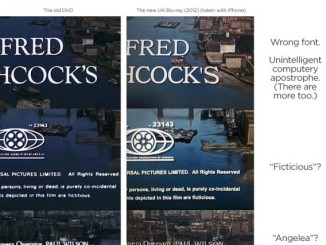
This time the film in question is Frenzy, Hitchcock’s 1972 thriller and the changes may seem trivial but are nonetheless vexing. Nick Wrigley over at Enthusiasm.org (via Salon) has discovered that on the UK blu-ray release of the film there have been some changes made to the opening titles and credits as illustrated in the image below.

And it is not just on the UK blu-ray either. Wriggley confirmed to Salon that he had heard from someone in the US who had seen the film on an HD channel and it too had the same spelling errors.

The answer seems obvious. Whoever did the high-def transfer must have been working from elements that did not include the original titles. Rather than take the time to either find and restore the original titles they took a quicker and easier way out.

Now granted this does not equate any fundamental change to the film’s story, but it does represent a change to the film as Hitchcock had intended it. Plus, the misspelling of the crew’s names is insulting to them and their families. And unless Universal goes back and corrects these errors, this is the HD transfer we will be stuck with for a good while, perpetuating the error and compounding the insult to the craftspeople involved.

So what’s it going to be Universal?

Comments (0)

Tags: , , ,

VERTIGO Unseats CITIZEN KANE in Sight And Sound’s Annual Best Film Poll

Posted on 01 August 2012 by Rich Drees

For the last five decades, Sight and Sound magazine’s every-ten-year-poll of film critics and filmmakers has always reached the same consensus – That Orson Welles’s 1941 film Citizen Kane was the greatest film of all time.

But the pillars of cinematic heaven were shaken today when Sight and Sound released the results of their latest poll which states that Alfred Hitchcock’s 1958 thriller Vertigo has taken the top spot, bumping Citizen Kane down to number two. Vertigo first made it onto the poll in 1972 where it tied at #11. By 1982 it was able to claw its way up to #7. In 1992 it had jumped to #4, and in 2002 it jumped again to #2.

Sight and Sound polled over 800 “film critics, academics, distributors, writers and programmers from all corners of the globe” in order to achieve the rankings announced today. (Disclosure – I was not asked to participate. The nerve.)

Here is the poll’s Top Ten -

1. Vertigo (Hitchcock, 1958)

2. Citizen Kane (Welles, 1941)

3. Tokyo Story (Ozu, 1953)

4. La Règle du jeu (Renoir, 1939)

5. Sunrise: a Song of Two Humans (Murnau, 1927)

6. 2001: A Space Odyssey (Kubrick, 1968)

7. The Searchers (Ford, 1956)

8. Man with a Movie Camera (Dziga Vertov, 1929)

9. The Passion of Joan of Arc (Dreyer, 1927)

10. 8 ½ (Fellini, 1963)

You can read all of Sight And Sound‘s coverage of their annual poll here.

I have to admit that I am a bit surprised by this turn of events. Not so much that the critical group-think has shifted somewhat. That was bound to happen over time. I’m just mildly surprised that the film to unseat Welles’s masterpiece was Vertigo as I frankly don’t think it is his best work. Sure, I would put it in his top five, where it would be sharing space with Strangers On A Train, Notorious, Psycho and North By Northwest. Granted these are based on personal preference, but in a way, aren’t all these lists?

Vertigo certainly wasn’t a big hit with critics when it was first released and even when the critical move to re-evaluate Hitchcock as an artist rather than as a showman started in the 1960s, the film was not one that would be part of those discussions. But Vertigo was one of five of Hitchcock’s films that were taken out of circulation in 1973 and I am forced to wonder if its reemergence to public view ten years later led critics to embrace it a bit more enthusiastically due to its renewed availability.

Comments (0)

Tags: , ,

Paramount Remaking Hitchcock’s SUSPICION

Posted on 14 February 2012 by Rich Drees

For the second time in the space of a week, an Alfred Hitchcock film is announced as getting a remake. Paramount will be producing a new version of Hitchcock’s classic Suspicion and has hired The Killing show runner Veena Sud to write the script.

Based on the 1932 crime novel Before The Fact by Anthony Berkeley, Suspicion starred Joan Fonatine as a newly married woman who gradually begins to suspect that new husband Cary Grant may be responsible for the death of a business partner. It was a performance that won Fontaine the Best Actress Academy Award that year.

Although Sud has plenty of television experience on such series as Cold Case, where she served as an executive producer, and The Killing, this marks her first feature film assignment.

Last Thursday, DreamWorks announced that it was remaking Hitchcock’s thriller Rebecca.

Via The Hollywood Reporter.

Comments (0)

Tags: , ,

Hitchcock’s REBECCA Is Set For A Remake From DreamWorks

Posted on 10 February 2012 by Rich Drees

As remakes of films have become more prevalent over the past several years, there were several directors and films thought to be sacrosanct and therefore immune from getting a modern day overhaul. But that looks like that is about to change with the announcement from DreamWorks that they are looking at a remake of Alfred Hitchcock’s classic thriller Rebecca.

According to Variety, Eastern Promises scripter Steven Knight will be handling the adaption, and will be working form the same novel by Daphne DuMauier that Hitchcock used for his 1940 film which starred Laurence Olivier and Joan Fontaine.

Normally, I would say that working from the same source material that Hictchcock used doesn’t necessarily constitute a remake, as Hitch would often use such things as a jumping off point to go in a different direction. A prime example would be his classic Psycho famously being inspired by the murders of Edward Gein, though the actual details between Gein’s murders and Hitchcock’s fictional Norman Bates’s killings are fairly different.

But in this case, with the exception of a few things mandated by the Production Code at the time, Hitchcock’s film follows DuMauier’s book fairly closely. This, of course, brings us to the question as to why DreamWorks would want to pursue the project. Perhaps Knight has pitched a story that starts with the basic story of DuMauier’s story but moves it in a different direction, similar to what Hitchcock would do when developing his films.

However, if that’s not the case, I have severe doubts that anyone can bring anything new or interesting to a story that Hitchcock has already so masterfully told, and I wonder as to who would have the hubris to try.

Comments (0)

Tags: , ,

PSYCHO Violinst Israel Baker, 92

Posted on 12 January 2012 by Rich Drees

Israel Baker, the violinist featured on the soundtrack of Psycho‘s most infamous music cue, died on Christmas Day in his Studio City home, the LA Times has reported. Baker had suffered a stroke several days earlier. He was 92.

As concertmaster for the Paramount Pictures orchestra, who composer Bernard Hermann used for recording the music for director Alfred Hitchcock’s classic thriller, Baker was the lead violinist for the passage of music that has been regarded as one of the most frightening pieces of film score ever recorded. Amazingly, the music was almost never written, as Hitchcock wanted the film to play out without any music. Hermann was able to convince Hitchcock otherwise. As you can see from the video below, the music makes a startling difference to the final product.

Although a majority of his career was spent performing classical music, Baker worked with a number of film composers including John Williams, John Barry, Franz Waxman, André Previn and Lalo Schifrin and played on dozens of film scores including Jonathan Livingston Seagull and Indiana Jones And The Temple Of Doom.

Comments (0)

Tags:

Happy Birthday Alfred Hitchcock!

Posted on 13 August 2011 by Rich Drees

Today is Alfred Hitchcock’s birthday. If he were alive today he would be 112 years old and nobody would be more surprised by that than him.

Besides being one of the defining authors of the thriller genre, Hitchcock had a wicked sense of humor and appeared in the background of nearly every film he ever made. To celebrate the Master of Suspense’s birthday, here’s a compilation of all those appearances.

Comments (0)

Tags: , , , , ,

Restored Hitchcock Silents To Screen At London Olympics

Posted on 07 July 2011 by Rich Drees

Restored versions of some of Alfred Hitchcock’s rarely seen, early silent films will be screened next year in England as an official part of the London 2012 Festival next summer, the finale of the Cultural Olympiad that runs concurrently with the 2012 Summer Games in London. The British Film Institute is behind the series of one-off screenings which will feature newly commissioned orchestral accompaniments.

Nitin Sawhney, who sites frequent Hitchcock collaborator Bernard Hermann as an inspiration, will be composing a new score to accompany the 1926 thriller The Lodger: A Story of the London Fog. Recent graduate from the Royal Academy of Music Daniel Cohen will be supplying a new score for Hitchcock’s The Pleasure Garden (1925). Ironically, The Pleasure Garden was Hitchcock’s first film and this will be Cohen’s first commissioned work.

It has also been announced that Tansy Davies will be providing a score for an as yet unnamed third film.

The BFI has been active as of late in restoring the early works of Hitchcock, specifically the films he made between 1925 and 1929, with their “Rescue The Hitchcock 9” initiative. Recently, the BFI received a grant of $250,000.00 from the Film Foundation, in association with the Hollywood Foreign Press Association, to aid in the restoration of four of the films from that era – The Lodger, The Ring, Blackmail and The Pleasure Garden.

Comments (0)

Tags: ,

Farley Granger, 85

Posted on 29 March 2011 by Rich Drees

Farley Granger, the actor who appeared in Alfred Hitchcock’s classics Rope and Strangers On A Train, has died yesterday at his home in New York City of natural causes. He was 85.

In Hitchcock’s Rope (1948), Granger plays a pianist who commits a murder with a school friend whom they believe is “inferior” to them. Hiding the body in their apartment and thinking that they can’t be caught, they invite their former teacher Jimmy Stewart and victim’s father and fiance over for a dinner party. In Strangers (1951), Granger played a young tennis pro who finds that an innocent conversation with Robert Walker has ensnared him in a double murder pack.

Spotted by a casting agent for Samuel Goldwyn while performing in a play, Granger was signed to a seven year contract while still in high school. His first film role was a small part playing a Russian in The North Star, a 1943 propganda film telling the story of the Soviet Union’s resistance to the Nazi invasion. he followed that with another war film, The Purple Heart (1944), before temporarily leaving acting for a stint in the Navy.

Upon his return to civilian life, Hitchcock cast Farley in Rope. He then worked with director Nicholas Ray in the thriller They Live By Night (1949). Granger also appeared in such films as Side Street, On Our Own (both 1950), I Want You (1951) and Hans Christian Anderson (1952).

In 1952, Granger bought out the remainder of his contract with Goldwyn and headed to Europe where he starred in director Luchino Visconti’s Senso (1954).Although he would return to Hollywood to make a few more films in the 1950s, Granger would eventually settle in New York City where his career would concentrate on stage and television projects. He would appear on Broadway in productions of Warm Peninsula, First Impressions, a musical adaptation of Jane Austen’s Pride and Prejudice, and a 1980 revival of Deathtrap.

Granger returned to Europe in the 1970s for a brief period to appear in such films as They Call Me Trinity (1970), The Man Called Noon and The Serpent (both 1973). His last film appearance was in 2001 the art world satire The Next Big Thing.

Comments (0)

Tags: ,

Going Psycho Over Aspect Ratios

Posted on 19 August 2010 by Rich Drees

The recent release of Alfred Hitchcock’s masterpiece Psycho on blu-ray disc in the UK and its impending blu-ray release in the US this fall have stirred up a bit of controversy in some quarters. It has nothing to do with the film’s content, which caused a bit of a stir when it was released, but in how you view that content.

Some folks feel that since Hitchcock shot the film using a 1.37:1 aspect ratio for composition that must have been the way that the director meant for it to be exhibited. And that the recent/upcoming blu-ray release of the film in an aspect ratio of 1.78:1, which would coincidentally fill up s standard high-definition widescreen television, is nothing less than a travesty and “visual vandalism.”

The lightening rod for this dustup is internet journalist Jeffrey Wells. No stranger to stirring the controversy cauldron, Welles wrote an impassioned article for his Hollywood-Elsewhere blog back in June decrying the blu-ray’s announced aspect ratio as nothing less than an insidious plot to rewrite the history of theatrical presentation of films of the late 50s/early 60s by proponents of the high-definition home video format.

OK, maybe he is being slightly hyperbolic when he stated that, but he does emphatically state -

The Psycho norm was never intended to be 1.78 to 1 (i.e., the widescreen aspect ratio for high-def video). For the most part Hitchcock expected his film to be shown within ratios of 1.66 to 1 (moderate rectangle) or 1.37 to 1 (next door to a perfect box).

Wednesday, Wells brought up the topic again, this time calling the release “rape” and “precisely the same thing as taking a razor blade and slicing off the tops and bottoms of Leonardo da Vinci’s ‘Mona Lisa’ in the Louvre.”

The thing is, though, is that Wells is absolutely and completely wrong on this.

True, no one so far has been able to produce a quote where the director gives his final say so on the matter. What we can do, is look to the film itself for vital clues as to Hitchcock’s mindset.

While Hitchcock obviously shot the film to protect the entire 1.37:1 image, – i.e., there are no lights or boom mics dropping into the picture from the top of the frame – there is more than enough evidence to support the fact that he intended the film to be seen at the wider ratio. The film’s opening credits were hard matted at 1.78:1 as were portions of the film’s infamous shower scene. That, to me, speaks volumes about Hitchcock’s intentions. There is the additional support of notation of the 1.78:1 aspect ratio on paperwork to the film developing lab at Pathe and the fact that storyboards for the shower sequence are also in the widescreen ratio.

But I think that through producing Alfred Hitchcock Presents, the director was probably far more cognizant of fact that any widescreen composed film of his would be subject to the indignities of pan and scan for the 1.33:1 television screen. Rather than let viewers loose picture information on either the right or the left of the television image, he chose to give them more by expanding the frame vertically. Filming in 1.37:1 allowed for that, with the option to have the film presented in theaters at a different aspect ratio remained through the ability of projectionists able to use plates to mask the image to the desired size.

In the days before letterboxing, this was probably the most elegant solution.

Wells argument sits predominantly on the crux of his aesthetic judgment of how the 1.37:1 version looks compared to the 1.78:1 version. He states in the comments of his June post that the “the somewhat higher, boxier framings are far more elegant, inclusive, well-balanced — they provide agreeable breathing space to the characters and compositions.”

That may be true, but the film isn’t about comfortable characters. It’s a Hitchcock film, and the means a continual ratcheting up of tension in both the film’s characters and its audience. Rewatching Psycho this morning, I was struck again how Hitchcock builds the tension through the first third of the picture as Marion Crane (Janet Leigh) first steals the $40,000 from her job and then goes on the run. As she drives, she imagines the voices of her boss and co-workers discovering her crime and their reaction. After she trades in her car for another vehicle, all the while being observed by a policeman, she imagines a conversation between the cop and the car lot salesman in which they find her actions suspicious. By the time she reaches the Bates Motel, Marion is a bundle of nerves, paranoia is starting to nibble away at her. Opening up the picture frame to all her “breathing space” will only dissipate the mood Hitchcock is trying to build.

(I have a similar critique about the Special Edition of Irvin Kershner’s The Empire Strikes Back. When George Lucas went back and digitally messed about with the movie in the late 90s, he added numerous windows to Bespin’s Cloud City. The end result dilutes much of the sense of claustrophobic urgency to the scenes of Lando, Leia, Chewbacca and C-3PO racing to save Han from Boba Fett.)

Welles is certainly welcome to his opinion. Aesthetics and beauty are in the eye of the beholder, after all. But that very subjective nature also means that it can’t be taken for fact. But arguing that something is correct simply because you like it that way will get you bounced off of a junior high school debate team. It’s certainly no way to prove your point in the grown up world.

And all of Welles’ verbal screaming and stamping of feet will not change that.

(Aspect ratio comparisons found at Hitchcock Wiki Forums.)

Comments (5)