Tag Archive | "History"

Tags: , ,

What TANGLED Could Have Looked Like

Posted on 07 December 2010 by Rich Drees

Early in its production, the Disney animated film that became known as Tangled was shaping up to be a much different movie than what is currently in theaters. In the early version being developed by director Glen Keane, two teenagers are transported from modern-day San Fransisco into the Rapunzel fairy tale and discover that they have to act the parts of the captive, long-haired princess and her rescuer prince. B ut in 2008, Disney’s incoming chief creative officer John Lassiter ordered a change of story direction and had the title changed from Rapunzel Unbraided to the one the film now carries. Keane stepped down as director and Byron Howard and Nathan Greno, director and storyboard director of Disney’s Bolt, took over.

While you can’t argue with the success of the finished product, it is interesting to speculate how the film may have looked if it went on its original course. The short pre-viz reel below, doesn’t give me much hope that it would have been all that great, honestly. (And yes, a previz, or pre-visualization, reel is supposed to look this rough.) The story sounds a bit like a reversed version of Enchanted, but I think that Keane was on to something with the animation, as we can see from the opening passage through the forest, from the 0:25 to the 1:00 mark. It looks like they’re combining the look of traditional, hand-painted animation backgrounds with the ability to rotate them through three-dimensions as one would a computer generated model. Hopefully, someone from Disney will look into using that style again, because it is stunning.

Via Cartoon Brew.

Comments (0)

Tags: , ,

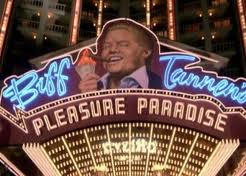
BACK TO THE FUTURE 2′s Complete “Biff Tannen Museum” Footage

Posted on 15 November 2010 by Rich Drees

The folks over at Back To The Future fansite BTTF.com have unveiled a pretty cool bit of production history from the second installment of the comedic time travel trilogy. It is the full monitor footage from the “Biff Tannen Museum” scene that serves to explain to Marty McFly (Michael J. Fox) how the alternate version of reality he is in came to be. While we do get to see some of the footage in the film,it has never been seen in its entirety until now. (I bet the folks who put together the recently released 25th anniversary DVD and Blu-Ray sets are wishing they knew of this footage’s existence while they were working on the project…)

BTTF.com got the footage from a fan who had connections to the production and who had been holding on to a video tape copy all these years.

The clip runs about three and a half minutes and gives us a glimpse at the depth of detail and thought that went into the making of the films.

Comments (0)

Tags: , ,

Edison’s FRANKENSTEIN Turns 100 Today

Posted on 18 March 2010 by Rich Drees

Today marks the 100 anniversary of the release of cinema’s first horror film, an adaptation of Frankenstein from Thomas Edison’s Edison Studios. To mark the occasion, we’re re-presenting our look at the history of the film and how it was rediscovered after being thought lost forever.

One of the most sought after short films by fans of the silent era is the 1910 production of Frankenstein from Thomas Edison’s Edison Studios. For many years the only image thought to exist from the 15-minute feature was a single photo of wild haired, shambling monster grimacing at the camera. Fortunately, recent years have revealed that it’s not as lost as one would think.

Frankenstein was filmed at Edison Motion Picture Studios located on the corner of Decatur Avenue and Oliver Place in the Bronx, New York, one of several dozens pictures the studio produced that year. The studio was built between 1906 and 1907 in response to the growing demand for films. Edison had been the leading pioneer of first kinetoscopes and then projected motion pictures. His first film studio, located near his laboratories in Orange, New Jersey, was too inconvenient to the majority of actors based in New York City. A studio opened on the roof of a building on 25th Street in Manhattan proved too small to keep up with the demand. The Bronx location was designed to be a state of the art facility to handle all of the Edison Company’s production requirements. It’s proximity to the end of the recently constructed Third Avenue El subway system is believed to have been so actors could slip away to make films without attracting the attention of their peers who may have disapproved of participating in the new and vulgar medium.

By 1908, the studio was in full operation, putting out several short, one-reel films a week. The motion picture arm of Edison’s business was also quickly becoming its most profitable- pulling in $200,000 plus an additional $130,000 from the sale of projectors. Still, Edison was losing his grip on being the sole technological innovator for the new medium as more studios sprang into existence with legitimate rights to certain patents.

To combat the problem, in 1909 Edison and his lawyers approached nine of the other top studios with the plan to form The Motion Picture Patents Company, commonly known as The Trust, to share patents, pool resources and keep control over everything from the manufacture of production equipment like cameras to film production itself. The Trust then set up the General Film Company to buy out the 52 leading film distributors, just so they could control the distribution of their films. Theatre owners were forced into paying a $2 a week fee for the rights to screen Trust films. (Never mind the fact that Edison’s company was earning almost a million dollars a year on from the other Trust members through patent royalties.)

As the popularity of motion pictures grew, so did the attention they received from moral crusaders and reform groups, who decried the new medium as being dangerous and encouraging of immorality. Some called for strict laws governing film content and some communities banned theatres all together. Knowing that these groups could pose a serious threat to his bottom line, Edison ordered that not only the production quality of his films be improved, but also their moral tone. The Trust even set up the first Board of Censors, consisting of film executives and religious and education leaders.

Frankenstein was the perfect choice to kick off production under this new moral banner. It’s a story that deals with the extremes of the human condition, life and death, and the dangers of tampering in God’s realm. Plus, Edison made sure that publicity stressed that some of the more sensational elements of the Mary Shelly’s novel had been toned down. The March 15, 1910 edition of The Edison Kinetogram, the catalog that the Edison Company would send to distributors to hype their new films, described the film as such-

To those familiar with Mrs. Shelly’s story it will be evident that we have carefully omitted anything which might be any possibility shock any portion of the audience. In making the film the Edison Co. has carefully tried to eliminate all actual repulsive situations and to concentrate its endeavors upon the mystic and psychological problems that are to be found in this weird tale. Wherever, therefore, the film differs from the original story it is purely with the idea of eliminating what would be repulsive to a moving picture audience.

One of those changes made to the narrative concerns the creation of Frankenstein’s monster. While Shelly’s novel did not go into specifics about the monster’s creation, the creation scene in the film certainly owes more to alchemy than science. The film certainly didn’t stress the danger of unchecked scientific experimentation, not when the boss has transformed the world with his own scientific marvels. Instead, the monster is cast more as a reflection of Frankenstein’s baser instincts and dark reflection of a mind that presumed to meddle in God’s domain.

The part of the monster was portrayed by Charles Ogle. He joined the Edison Stock Company Players in 1909 and had essayed parts as far ranging as Scrooge in a 1910 production of A Christmas Carol to George Washington in a series of films on the history of the United States. Since actors at the time were responsible for their own wardrobe and makeup, Ogle was probably the one who developed the monster’s shambling appearance, perhaps inspired by drawings of how actor Thomas Porter Cooke looked for an 1823 English Opera House stage production of the novel called Presumption or the Fate of Frankenstein.

Edison Stock Company Player Augustus Phillips was chosen to portray the role of the monster’s creator Frankenstein. Very little is known about this actor beyond the films that he made at Edison and then Columbia Pictures. He continued to make features into the early `20s at Pathe, Metro and Goldwyn studios.

Rounding out the cast is Mary Fuller as Frankenstein’s fiancée Elizabeth, though she is never referred to by name in the film. She had joined the Edison Stock Company Players in 1909 and would ultimately appear in a reported over 500 productions, often with Charles Ogle. She was also one of the first motion picture stars to receive an on screen credit in 1911 for her lead role in Aida.

The film’s director was J. (James) Searle Dawley and had started at Edison as a writer in 1907. He was soon apprenticed to director Edwin S. Porter who had shot the landmark The Great Train Robbery in 1903. A quick study, Dawley was soon directing his own films at Edison within a year. Stylistically, Dawley was the antithesis of Porter though. Porter is generally credited with the development of much of the language of cinema including matched edited shots and the close up. Dawley preferred to shoot each scene as if it were a play, with the camera stoically removed from the action.

As director of the film, Dawley was responsible for personally overseeing every aspect of the production from writing the script to approving the set construction and Ogle’s makeup design. In this respect his job was more synonymous with what both a producer and a director would do today. He was only answerable to studio head Horace Plimpton. As was the case with most of his films, it is assumed that Dawley wrote the scenario for the film himself. It is unknown whether Edison himself encouraged or approved the production at its start as he made only rare appearances at the Bronx studio. More than likely, the go ahead was given by the Studios managers, making sure that the script would conform to the decrees of the Trust’s Censor Board.

The film opens with Frankenstein leaving to study at University, bidding goodbye to his sweetheart. Two years pass and Frankenstein has finished his contemplation of the mysteries of nature and seems ready to try his own hand at God’s work. However, his attempt at creating life goes awry, with a hulking, twisted creature emerging from the alchemical vat. Aghast at his creation, Frankenstein returns home to marry his fiancée and escape his mistake. But the creature follows him and confronts his creator, tormenting him. But, as the film’s final title character tell us, the creature “is overcome by love and disappears” into a mirror in Frankenstein’s study.

Most films were shot in a day, but due to the special effects work involved Frankenstein’s production lasted nearly a week, stretching from some time between January 13, 1910 to January 19, 1910. (What little records survive are unclear. It is known the Dawley was out of the country filming in Cuba by January 19th. Some sources state that studio head Plimpton approved the film’s scenario on January 14th.) The film was completed and sent over to the Orange County, New Jersey offices for approval on January 28th and received that approval on February 1st. Over the next two weeks, musical accompaniment was picked and certain scenes were run through a stenciling machine to be tinted.

Edison had pioneered the idea of tinting films to add color in 1884. Edison Studio’s Annabelle the Dancer, featuring music hall performer Annabelle Moore recreating her stage act “The Butterfly Dance,” was one of the first commercially projected motion pictures and was first exhibited at the Cotton States Exposition in Atlanta, Georgia in mid-September 1885. Since her act used a projection of colored stereopticon slides as she danced with long silk draperies, Edison touched on the idea to have prints of the film hand painted frame by frame, in the same manner that some photographs and portraits were tinted at the time. By 1910, tinting of films had become common, with blue often being used for night scenes, green for woodland scenes and so on.

In the second half of February, the film was assembled with each scene was pasted together to form a complete print. In early March, Edison Studios copyrighted the picture and submitted paper prints of several scenes to the Library of Congress. In a cost cutting measure started right before the turn of the century, the studio had begun to have a positive print of each film developed on sheets of paper instead of actual film prints for submission for copyright. (The studio would later switch to paper rolls.) That a number of Edison films that have survived did so mainly through the existence of these paper prints. Currently, the Library of Congress only has selected scenes from Frankenstein, not a whole copy.

The film premiered on Friday, March 18, 1910, a mere two months after it had finished shooting. Such a quick turnaround was not uncommon at the time. There was great demand for films and the week of Frankenstein’s release there were over 30 films released by Trust members. The film was received favorably by critics. The New York Dramatic Mirror in a review published on 3/26/10 stated “This deeply impressive story makes a powerful film subject, and the Edison players have handled it with effective expression and skill.”

However, Frankenstein did not generally do well with audiences. There are several possible reasons that may have contributed to its less than stellar reception. Frankenstein was the first horror movie and audiences possibly weren’t sure what to make of this weird story. Moving pictures were already becoming more sophisticated with the use of close-ups and editing within a scene becoming more common. It’s possible that audiences found director Dawley’s stage-y, wide shots to be old fashioned.

It has also been reported that in some communities there was objections to the film due to its perceived blasphemous content. Debates were ongoing around the country over Darwinism and a film that could be seen as mocking the creative power of God was sure to draw fire from the pulpit. Regardless of the reasons, the film made its distribution rounds and was then withdrawn from circulation. While some films like 1903’s The Great Train Robbery remained popular and in circulation for years, Frankenstein quickly faded from the public’s minds.

At the time, Edison Studios would only strike approximately 40 prints of each of their productions, which would then be sent out for distribution. After the films had circulated for seven months or so, they were returned where they were stripped for their silver content. The films were quickly forgotten by the studio and the public and no thought was given to any future value they may hold. That even a handful of Edison Studios films still exist on celluloid is only due to the efforts of private collectors.

And the fact that just a single print of Edison Studio’s Frankenstein still exists is all due to one Wisconsin film collector, Alois Felix Dettlaff Sr., and a little bit of luck. The print in his possession had originally belonged to his wife’s grandmother who used to screen it along with a silent version of Hiawatha. As he relates in Frederick C. Wiebel Jr’s self-published book Edison’s Frankenstein, “She dressed up as an Indian and danced on the stage, and she had short subjects along with it, and one of them was Frankenstein.”

However, the film would take a roundabout way to Dettlaff’s possession. After his wife’s grandmother left show business, she passed her film collection and projector to her son, who in turn passed them on to his son, Dettlaff’s brother-in-law. Not knowing what he had in the collection, Dettlaff’s brother-in-law sold the entire collection to a film collector, who then sold it to another collector of Dettlaff’s acquaintance, from whom Dettlaff purchased them in the mid 1950s. Since he was running silent films for his children as a way of teaching them to read, he did screen the film. However, noting that the film had some wear and tear, and about 8% shrinkage due to age, he placed the print aside, so as not to damage it further.

It was in 1963 that a film historian discovered the March 15, 1910 edition of The Edison Kinetogram with its picture of Charles Ogle in full make up on its cover in the Edison archives in New Jersey. The picture was published in numerous magazines and books, sparking interest among film buffs worldwide. But no print could be found. In 1980, the American Film Institute declared the 1910 production of Frankenstein to be one of the top ten most “Culturally and historically significant lost films.”

When Dettlaff heard of the film’s placement on the AFI’s list, he announced that he had indeed had a copy. However, knowing the worth of such a treasure, Dettlaff has been reticent about releasing the film to be seen. In the late 1970s he had allowed a few minutes to be shown as part of a BBC documentary, later released to home video. These snippets would later wind up in various silent cinema video compilations without attribution or payment made to Dettlaff. Feeling slighted and perhaps not appreciated for his archival efforts, Dettlaff has been guarded in allowing the film to be screened. In 1986, he donated a “copyright protected” version of the film, with a copyright notice that scrolled across the center of the film making viewing difficult, to the Academy of Motion Pictures Arts and Sciences. He has also reportedly made numerous safety copies of the film on 16 and 35 mm.

In 1975, at the urging of TV news photographer Charles Sciurba, Dettlaff undertook making a copy of the film with the aid of Clarence Stelloh, who had worked as an engineer at Western Electric during the early days of sound film. Working over several weekends, the pair used a 16mm camera and a modified step printer to copy some 14,000 to 15,000 images at a rate of one to two frames a second to create a 16mm backup copy of the film. Complicating the project was the fact that the film had shrunk by up to 8% at some spots, necessitating Stelloh to make changes to the printer to accommodate for the varying space between the sprocket holes.

Detlaff held the first public screening of Frankenstein in decades on October 30, 1993 at the Avalon Theater in his hometown of Milwaukee. It was the first of several annual screenings at various venues in the city. In April 2003, Dettlaff screened the film at the Landmark Loew’s Jersey Theatre in Jersey City, New Jersey as part of a weekend long festival of Frankenstein films. Both evenings’ shows were packed with people curious to see the fifteen-minute short that has so captured the imaginations of film buffs through just one frame. The screening was also used to launch the film’s release on DVD, available from Dettlaff’s own A. D. Ventures, International.

Comments (1)

Tags: , , ,

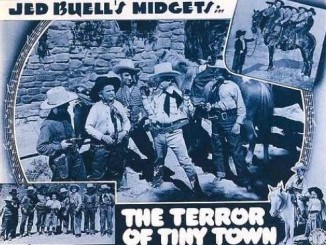
Friday Flashback: THE TERROR OF TINY TOWN

Posted on 05 February 2010 by Rich Drees

We’re going to celebrate the shortest month of the year over the next few weeks by taking a look at movies featuring some of cinema’s shortest actors. (No Tom Cruise jokes, I promise.) First up is the 1938 cult classic western The Terror Of Tiny Town.

Billed as a “rollickin’, rootin’, tootin’, shootin’ drama of the great outdoors”… “with an all-midget cast,” The Terror Of Tiny Town is probably known to most people more by reputation than by dint of having actually been seen. Hollywood legend has it that producer Jed Buell got the idea for his film when he overheard two employees of his production company discussing the depressed status of the film business saying “if this economy doesn’t turn around, we’ll have to start making pictures with midgets.” And the rest, as they say, is cinema history.

Sure, a western, or any genre film for that matter, with an all little people cast is a gimmick. But when the novelty of its cast wears of, which it does fairly quickly, what are we left with? Unfortunately the answer is, “a rather lousy western.” Frustratingly, outside of a few (unintentional?) sight gags, such as walking under a saloon’s swinging doors, and ironic bits of dialogue (“One day I’ll be the biggest man in the county!”), even the movie itself seems uninterested in its own gimmick. Why is the town built for average-sized people? Was it abandoned only to be re-populated later by little people?

Bat Haines (“Little Billy” Rhodes) is the black-hatted villain of the piece, pitting against each other two ranches with a long hostory of animosity in the hopes of grabbing both their lands and cattle. It is a fairly story and it is not helped by the fact that a majority of the cast are not trained or very talented actors. A bit of a Romeo And Juliet love story between Billy Curtis and Yvonne Moray doesn’t do much to liven up the procedures. And even though it clocks in at a trim 62 minutes, The Terror Of Tiny Town winds up feeling longer.

The scene below pretty much illustrates my point.

Many of the actors in The Terror Of Tiny Town would of course go on to appear as Munchkins the following year in MGM’s The Wizard Of Oz. Star Billy Curtis would go on to have a decent and long career all the way up to the mid-1980s. Oddly enough, although there have been films where little people make up a majority of the cast (Under The Rainbow, Time Bandits, Tom Cruise’s home movies) no one has ever tried to make another film with a cast exclusively consisting of them. Which I guess makes The Terror Of Tiny Town the best all-midget movie ever, if only by default.

Comments (0)

Tags: , , , ,

The Singing Swashbuckler: A Musical MARK OF ZORRO

Posted on 19 January 2010 by Rich Drees

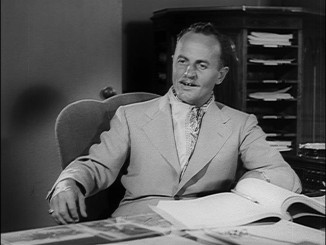
Hollywood recycling its own material is certainly not a new trend. Ever since the days of the early talkies, studios have drug out old stories, slapped a bit of spit and polish (and usually a new title) on them and shipped the results out to theaters as a matter of routine. In some instances the overhauls were a bit more dramatic. One particular case in point is 20th Century Fox’s first attempt to remake The Mark Of Zorro. While Fox would eventually have a classic with their version starring Tyrone Power in 1940, when studio production chief Darryl F. Zanuck originally conceived in 1936 of redoing the story of a swashbuckling Spanish aristocrat who frees the peasants of Spanish California from the rule of a tyrannical governor, he envisioned it as “a delightful romantic comedy drama of adventure and song.” A musical.

It is unknown what gave Zanuck the initial idea of turning the hero of Johnston McCulley’s adventure stories into a singing, romantic hero. Perhaps he was looking for a unique spin on the story to interest the public. But as head of the recently merged Fox Film Corporation and 20th Century Pictures studios, he had a responsibility to deliver some sure fire hits for the new company and must have thought that this could have been a sure-fire winner.

Writer Bess Meredyth, a contract writer at the studio, was assigned by Zanuck to develop a new story outline based on the original 1920 silent version which starred Douglas Fairbanks. Songwriters Arthur Schwartz and Irving Caesar (That Girl From Paris, A Star Is Born) penned six songs for the project. Presumably somewhere in a file in Fox’s archives lies sheet music for such unheard tunes as “My Saddle Is My Throne,” Zorro’s main song, “The Night Has Lost The Moon,” “Lolita Love Song” and three other tunes.

Very little has ever been published about this aborted project. The only mention I have ever been able to find is in Rudy Behlmer’s book A Memo From Darryl F Zanuck. In it, Behlmer reports that  notations made by Zanuck on Meredyth’s 1936 outline for the film indicate that he was eyeing the project for possible Technicolor treatment and maybe even location at the Grand Canyon. It was definitely going to be an A picture for the film.

In the lead role of Zorro, Zanuck envisioned opera singer Lawrence Tibbett. With his good looks, the popular Metropolitan Opera bass was one of the first opera singers to take a stab at a film career, though with mixed results. Tibbett had the lead role in Metropolitan (1936), the first film released from the newly formed 20th Century Fox studios. Although it opened at Radio City Music Hall to strong, positive reviews, the public was apathetic. With the film flopping at the box office, it seems as if Zanuck reconsidered his idea of Tibbett heading up a musical version of Zorro.

While Zanuck would go on to bring Zorro to the silver screen just a few years later, with Tyrone Power headlining, the idea of a musical version of the story stayed with him.

In an August 1943 reprinted in Behlmer’s book, Zanuck asked the head of Fox’s story department Julian Johnson, to look into the possibility of reviving the screenplay and songs developed in 1936. What sunk the development of a musical Mark Of Zorro this time around is unknown. Perhaps Johnson saw some potential problems with the basic idea and argued Zanuck out of it. Maybe Zanuck lost interest or changed his mind on his own. It is possible that there was some other financial or business consideration that brought the enterprise to a halt.

And while Zanuck’s vision never reached the screen, another crooning adventurer would make his way to the big screen in a manner of fashion. Stanley Donen’s 1952 Singin’ In The Rain was a love letter to the early talkie era and featured in its plot a silent film about a dashing and romancing cavalier that is retooled into a musical version of the same story. Could screenwriters Adolph Green and Betty Comden, who interviewed several MGM studio employees who were around during that time as research, perhaps heard of Zanuck’s attempt over at Fox with Mark Of Zorro and used it as a partial basis for their own story? It’s possible, but with all of the principals involved long gone to that big movie palace in the sky, we may never know.

Comments (2)

Tags: , , , ,

Cameron’s Short Film XENOGENESIS

Posted on 04 January 2010 by Rich Drees

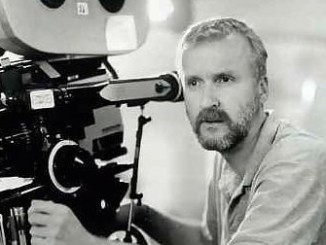
With the worldwide box office for James Cameron’s eye-popping Avatar passed the $1 billion mark this past weekend, it might be a good time to look back at the director’s humble beginnings, a short film called Xenogenesis. Produced independently in 1978, this is Cameron putting all his self-taught knowledge on movie making into practice for the first time. And watching the film, it is easy to see Cameron firs exploring some ideas that he will continue to explore all the way up to Avatar- tough female characters, futuristic struggles between man and machine, funky powerful exo-suits. The film impressed the folks at Roger Corman Studios, who hired him on the basis of his work here as a special effects technician and model maker. he would work on such films as the Star Wars knockoff Battle Beyond The Stars and Escape From New York, before stepping in to his first directorial gig on Piranha II: The Spawning. And I think that we know the rest of the story from there.

Comments (0)

Tags: , , ,

Lynch Talks About Almost Directing REVENGE OF THE JEDI

Posted on 17 December 2009 by Rich Drees

DavidLynchIt’s a well known story that David Lynch was once offered the director’s chair for Return Of The Jedi by Star Wars creator George Lucas. Although Lynch turned the offer down, he never really discussed how the meeting between himself and Lucas went until recently, when he spoke about it last month at a speaking engagement at New York’s Russian Tea Room.

Given Lynch’s own science-fiction film Dune, which he released just a few years after Jedi, it is hard to imagine what kind of film Return Of The Jedi would have been if he were to be given free reign by Lucas. But the truth of the matter is that Lynch would have been strictly a director for hire on the project and very likely would have chaffed under the micro-management that Lucas supposedly subjected Richard Marquand, the director who eventually won the job, to. If he just didn’t walk off the picture, I wouldn’t be surprised if Lynch would have wound up taking his name off the film, perhaps giving credit to “Judas Booth,” the name he had placed on the extended TV version of Dune assembled without Lynch’s participation or approval.

And if you’re having trouble wrapping your head around a Lynch-helmed Return Of The Jedi, your brain will probably explode contemplating what another project he was offered to direct that he declined would have looked like- Fast Times At Ridgemont High.

Comments (0)

Tags: , , , , , , , , , ,

…And Starring The Statue Of Liberty

Posted on 28 October 2009 by Rich Drees

StatueOfLibertyWhen a movie’s story wants to change location from anywhere in the world to New York City, the chances are good that the transition will be done by cutting to a shot that features the Statue of Liberty. Arguably one of the world’s most recognizable landmarks today marks the 123rd anniversary of her dedication. And over those years that she has stood in New York Harbor, she has found time to make several film appearances.

National Treasure: Book Of Secrets (2006)

The Statue of Liberty was sculpted by Frenchman Frédéric Auguste Bartholdi, who first created a smaller version 22 meters high which now stands on the Île des Cygnes in the Seine in Paris. It also struck screenwriters Marianne and Cormac Wibberly as a good place to hide a clue for Nicholas Cage’s historian/adventurer Ben Gates to find in National Treasure: Book Of Secrets. Although it wasn’t a great movie, it did use several little known bits of United States history for plot points.

Saboteur (1942)

With its release during World War Two, director Alfred Hitchcock knew that the use of the Statue would have a big impact on his film’s audience, representing all the ideals that the country was fighting and sacrificing for. Robert Cummings plays a man wrong accused of setting fire to a California airplane factory. Evading the authorities he chases Norman Lloyd across country to Manhattan where the film climaxes on the Statue’s torch. Hitch would go to revisit the idea of setting a film’s finale atop a national monument with North By Northwest, with Cary Grant and Eva Marie Saint being chased across the top of the monument by James Mason’s goon Martin Landeau. You can view the climax of the film below, but I’d recommend watching the whole picture. It’s Hitchcock after all.

Remo Williams: The Adventure Begins (1985)

In 1984, the Statue began a much needed restoration. Scaffolding was erected around the entire 151 foot tall structure. It was only natural that someone would look at that and think “Action Sequence.” As its full title none-too-subtly suggests, Remo Williams was intended to be the first in a franchise of adventures based on the satirical-action Destroyer novel series written by Warren Murphy and Richard Sapir. Remo Williams (Fred Ward) was a New York City cop who is recruited into an ultra top secret organization CURE. He is turned over to Chiun (Joel Gray, under some great prosthetics that earned the Best Makeup Academy Award that year), an ancient Korean who schools Remo in the ancient art of Sinanju, the first and still purest of all martial arts. CURE is also investigating an arms manufacturer who has been ripping off the government. While Remo is being trained on the Statue, he is attacked by hired goons of the arms manufacturer and the stage is set for an entertaining climb up and down the scaffolding. While there was some location work done at the Statue, a majority of the sequence was shot on an outdoor set built in Mexico. You can see a bit of the Statue of Liberty sequence in the film’s badly edited trailer below. (Really Sony, that is terrible, even by 1980s standards.)

XMenStatueOfLibertyX-Men (2000)

The Statue Of Liberty becomes the focal point from which villain Magneto (Ian MacKellan) hopes to strike at a gathering of the world’s diplomats on nearby Ellis Island, by using it as a base for a machine that will rewrite the diplomats DNA to make them all mutants. Regarded as a terrorist by the governments of the world, Magneto sees his actions as leading to the liberation of all mutants from the discrimination that they are being subjected to, making the use of the Statue all the more symbolic, at least in his mind. It also leaves the audience to ponder the axiom about one man’s terrorist being another man’s freedom fighter. And the fight between Wolverine (Hugh Jackman) and Sabertooh (Taylor Mane) on top of the Statue’s crown, actually manges to one-up the Remo Williams sequence.

Planet Of The Apes (1968)

As a symbol of New York City, the Statue has always been a in the cinematic crosshairs when filmmakers need to show that something BIG has happened to Manhattan, and usually by extension, the world. It has been knocked over into the New York Harbor by alien invaders in Independence Day, frozen solid in The Day After and decapitated by a giant monster in Cloverfield. But the most iconic stature destruction still remains the first- Its appearance before Charleton Heston in Planet Of The Apes, signaling that the astronaut was planet but in a future where humanity’s once proud civilization had fallen. Not surprisingly, this revelation comes from the mind of Twilight Zone creator Rod Serling, who worked on adapting Pierre Boulle’s novel for producer Arthur P. Jacobs. It was, and still is, a powerful image, one that twsts the knife on Heston’s character and the audience as well. So engrained in even the most casual movie watcher’s consciousness is the image that it has been spoofed by both Mel Brooks in Spaceballs and Kevin Smith in Jay And Silent Bob Strike Back and director Tim Burton didn’t even try to recreate it for his 2001 remake.

Comments (2)

Tags: , ,

Lost Three Stooges Interviews To Air On Sirius

Posted on 30 July 2009 by Rich Drees

ThreeStoogesInterviews conducted in the 1970s with Three Stooges stars Moe Howard and Larry Fine that have gone unheard for nearly four decades will air tomorrow (Friday, July 31st) at 2 pm on one of the two Sirius-XM Satellite Radio channels programmed by life-long Stooge fan Howard Stern.

“The Three Stooges: Lost and Found Interviews” has its origins in an interview last May Stern did with Dancing With The Stars host Tom Bergeron, who admitted that he had interviewed Howard and Fine back in the 70s when he was a teenage radio disc jockey. Intrigued about what the two classic film comics had to say about their careers, Stern asked Bergeron if he still had the tapes and offered to air them on his channels. After some searching, Bergeron was able to locate the tapes and soon wheels were set in motion to bring them to the the public.

The special, hosted by Bergeron, will air on Sirius-XM channel 101.

While I’m not much of a Stooges fan, I am planning on tuning in for this. The interviews were done back in the sunset of their lives, Fine was just a few months away from his death, so it should be interesting to see how they look back at their careers. Accrding to a Sirius-XM press release, “[o]n the tapes, both Moe and Larry discuss the history of the Stooges plus the Curly/Shemp/Curly-Joe/Joe ‘third stooge’ evolution. Larry reminisces about working with Charlie Chaplin and Buster Keaton, in one memorable moment, Moe takes a swipe at legendary comedians Jerry Lewis and Bob Hope.”

The special will also feature several of the Stooge-themed comedy bits that have appeared on Stern’s show over the years, so expect to hear several instances of voice artist Billy West’s dead on Larry Fine impersonation.

Comments (0)

Tags: , ,

Walter Cronkite Demos TRON Special Effects

Posted on 20 July 2009 by Rich Drees

cronkitetronLast Friday, the great journalist Walter Cronkite passed away at the age of 92. With his soothing baritone voice conveying the right mix of warmth and gravitas, Cronkite reported to America not only the biggest of the century, but his coverage of the space program documented some of the most important moments in all of human history.

But despite his position as “The Most Trusted Man In America,” many of the retrospectives about the anchor that aired this past weekend pointed out the anchor’s playful side, a side that peeks out in the embedded clip below. It is from a news report that must have aired shortly before the release of Disney’s groundbreaking 1982 film Tron. And while he had reported on many history changing events, I wonder if even he realized at the time the revolution he was reporting on.

In the short piece, Cronkite introduces viewers to the still in its infancy field of computer-generated visual effects and the joins with the film’s visual effects supervisor Harrison Ellenshaw, who places him into the film’s world-within-a-computer. The video quality of the clip isn’t the greatest, but presumably CBS has a cleaner version that could perhaps one day be included on a future DVD or Blu-Ray release.

Comments (0)