|
SAVING PRIVATE RYAN Is Just D–DAY: THE RIDE
By Michael McGonigle
I enjoyed him in such films as Noises Off, Remains Of The Day, Deathtrap and of course Superman. But my final memories of Christopher Reeve were of him using his celebrity status to increase research funding for spinal injuries after a 1995 horse riding accident paralyzed him from the neck down. It was a cause that meant more to him than just returning to movies and TV.
Reeve championed stem cell research; he worked tirelessly on something called “Locomotor Training”, all in an attempt to walk again, something considered impossible by doctors. Yet, through sheer will power and massive amounts of expensive physical therapy, Reeve was able to breathe for periods up to 30 minutes off his respirator; something else doctors thought impossible.
Reeve even managed to achieve independent locomotion, sort of, when he appeared in a 2000, Super Bowl TV commercial where, through the magic of CGI, he walked across a stage to accept an award, fooling many people into thinking he had really overcome his paralysis. At the time of his death, the eponymous Christopher Reeve Foundation was actively researching spinal cord injuries and supposedly, Reeve had even regained control of his left index finger.
Upon Reeves sad, but not unexpected death, the radio, TV and newspapers were full of celebrities, commentators and politicians from all sides of the political spectrum praising Reeve for his ceaseless efforts in trying to walk again. Christopher Reeve was truly a “Superman” who never gave up hope, went the refrain. But I noticed something curious about these fulsome encomiums.
Most were made by able-bodied people.
What, I wondered, did the paralyzed community think of Christopher Reeve? I wasn’t looking for dirt, I was only curious, but what I found surprised me. Other, less famous people with spinal injuries were generally unimpressed with Mr. Reeve and his “Foundation”.
A common complaint was that in using his celebrity status and money in trying to walk again (something unlikely at best), Reeve ignored very real issues like access to housing, public transportation and other quality of life tangibles that could have helped a lot more paralyzed people. Particularly the kind who don’t have foundations named for them, get standing ovations at the Oscars or have Robin Williams visit them in the hospital. Of course, Christopher Reeve could do whatever he wanted with the money he raised for his foundation and I’m sorry he was paralyzed, but that does not make him critic proof. Nor does it mean that everything he did was correct or helpful or even the best use of the money he raised.
What does this have to do with Saving Private Ryan? Well, I have noticed that among the reviews of that 1998 Steven Spielberg directed film, especially those claiming that the D-Day invasion scenes are the most accurate and realistic ever filmed, were made by people who have never been in combat or even in the military.
Lack of military service does not mean you can’t hold an opinion on Saving Private Ryan, nor does it mean you can’t understand what combat is like; anymore than you have to be an astronaut to appreciate Apollo 13. It just means you should probably hold off on passing judgment on the films “realism” until you have at least done some research.
I have also noticed that lots of people use an unquestioning praise of Saving Private Ryan as a way to substantiate their own patriotism. And, if you are critical of Saving Private Ryan, you must be an elite, left wing, liberal, fag, Femi-Nazi, Commie.
Yes, I have been called all that and more because I don’t swallow the trite and simplistic mythos Saving Private Ryan tries to sell. Listen up folks, I do like the film, but I still think its bullshit. To understand the Saving Private Ryan myth, it might be helpful to take a cursory look at the career of Steven Spielberg.
Spielberg has recalled making films as a child with WWII themes and the first film he made after the immense commercial success of Jaws and Close Encounters Of The Third Kind was an expensive WWII themed film called 1941. 1941 turned out to be a financial failure although to be fair, the film is not as bad as critics said it was. As the 1980’s began, Spielberg was approaching his mid-thirties and he desperately wanted to be considered a “serious” filmmaker, not just a commercially successful one. So, after the 1,2,3, combo-punch of Raiders Of The Lost Ark, ET: The Extraterrestrial and Indiana Jones And The Temple Of Doom gave Spielberg more money than God, it was now time to get serious.
If Spielberg had wanted to, he could’ve directed a film based on the Yellow Pages, but in 1985, the Jewish, Caucasian, Upper Middle Class raised Steven decided the female African American experience in the Deep South spoke to him and he made a film based on Alice Walker’s epistolary novel The Color Purple, which received many critical hosannas. The Color Purple also received 11 Academy Award nominations; none for Best Director though. Rubbing salt into an already open wound, the film went on to win no Oscars at all. Was The Color Purple a serious attempt by Steven Spielberg to stretch his cinematic skills or was it Oscar pandering? Only he can answer that.
His next film was the 1987 Empire Of The Sun, another serious film based on a serious novel with a WWII story line. Empire Of The Sun failed to win him any respect or awards, but it did introduce the world to Christian Bale, so something good definitely came of it. After ending the eighties with The Last Crusade, another successful Indiana Jones sequel, the nineties began rough for Spielberg. Although released at Christmastime in1989, Always was a flop and Hook, from 1991 was universally panned by critics and audiences alike.
But 1993 was Steven Spielberg’s Annus Mirabilis. His adventure film Jurassic Park was a huge hit and in the fall of that year, the Holocaust themed Schindler’s List became an Academy Awards juggernaut. When Spielberg won the Best Director Oscar for Schindler’s List, he expressed his thanks very honestly when he said, “This is the best drink of water after the longest drought in my life”. He tried another popular film/prestige film combination punch in 1997 with the summer release of The Lost World, the Jurassic Park sequel and then in December he released Amistad, a serious film about a famous revolt on slave ship. Once again, despite several nominations, Amistad failed to win any Oscars, but it did introduce the world to Djimon Hounsou and we’re all better for that.
So, by 1998 having failed twice to win respect by looking at issues of race in his films, Steven Spielberg announced he was going back to the horrors of a bloody beach and no, he wasn’t talking about a Jaws sequel. He was looking at D-Day, that historic invasion of France by Allied troops in June 1944. WWII had been good to him before, so why shouldn’t it be good to him again?
The story for Saving Private Ryan was based on the true story of the Niland Brothers, four brave American siblings who ended up invoking the US Military’s Sole Survivor Policy when three of the brothers were determined to be dead and the fourth was ordered home by the top brass whether he wanted to go or not. This kind of story would very much appeal to Steven Spielberg. It had the sentimental mushy side he liked along with the technical challenges he enjoyed overcoming.
Yes, he could make a film that looked back at a simpler time, to a war that was clearly the “Good Fight”. If you didn’t think too hard, WWII could be portrayed as a war that had none of the messy moral ambiguities that bedeviled the Vietnam War. Besides, he would also get to blow things up real good!
Consider, by the time Spielberg was making Saving Private Ryan, WWII had recently been commemorated in a variety of fiftieth anniversary events and the celebrated anchorman Tom Brokaw was busily working on his book with the questionable title, The Greatest Generation. These two disparate entities would dovetail together very nicely.
Spielberg has claimed in interviews that one of his purposes in making Saving Private Ryan was to specifically honor the soldiers who fought in WWII; a noble sentiment. But being a film buff, you’d think Spielberg would be familiar with the constant stream of films from the 40’s through the 50’s into the 60’s and beyond including TV shows that did just that. It makes me wonder if he had another purpose in making Saving Private Ryan.
Seems like he did. In a 1999 episode of the AFI Series The Directors about him, Steven Spielberg says another reason for wanting to make Saving Private Ryan was to make a visually different kind of WWII film. He wanted the opening D-Day sequence to be shot without the usual Chapman cranes and Steadicams. He wanted to pare down the film mechanics so the scene would look like a real war cameraman shot it.
So, Spielberg wanted to film D-Day like a Dogme 95 film. That’s an uninspired aesthetic choice for such a talented director, but it was his to make. So now we can look at his execution of that choice and I am not convinced that a “realistic” viewpoint is achieved by eschewing the use of Chapman cranes and Steadicams. Or, by the shaky look of the beach landing sequence, the use of tripods either. But, if you are trying to achieve a documentary like feel, is artificially slowing down the speed of the film OK? What about purposely de-saturating the film by 60% so reddish colors (like blood for instance) show up more prominently? What about heavily manipulating the soundtrack? Does war exist in Dolby Digital surround sound? Yet, these cinematic choices were OK’d by Steven Spielberg.
I mean, what are we REALLY seeing in Steven Spielberg’s D-Day re-enactment? What has Spielberg done other than simply add an element of “Chainsaw Massacre Movie” gore to the war film, a genre that has, throughout its history remained surprisingly non-gory? Does the Omaha Beach sequence in Saving Private Ryan really look like combat? Or does it just resemble a filmmaker’s approximation of combat no matter how skillfully it may be made?
This is what annoys me most about Saving Private Ryan and it’s not really the fault of the film. It’s the way so many people fatuously praise the film as being the most accurate and “realistic” vision of battle. A bunch of different critics even stated that Saving Private Ryan avoids all the clichés usually associated with WWII films.
Avoids WWII film clichés? Have any of you seen it? Lets just start with the squad who goes after Private Ryan in the film, do we have the decent guy from the Midwest, check, Tom Hanks, do we have a vaguely ethnic type, check with Vin Diesel as Caparzo. How about a young coward who later on shows courage, check with Jeremy Davies tri-lingual interpreter who surprisingly does not know what FUBAR means. What about the wise guy from New Yawk, check with Ed Burns. Did we forget the country boy sharpshooter, nope, we have Barry Pepper as a cross kissing sniper, but you get my point. You may just as well have cast Anthony Quinn, Wally Cassel, William Bendix, Lloyd Nolan and Richard Jaeckel.
After suffering terrible human losses and with the water being too choppy for the tanks, (only 2 of the 29 tanks ever made it), the surviving men hunkered down at the sea wall while Navy destroyers pulled in close, even scraping their bottoms, while they relentlessly shelled the German fortifications. Eventually, the surviving troops climbed up the sides of the bluffs, double-backed and attacked the Germans from behind over running them.
Anybody remember the Navy destroyers or the sinking tanks in Saving Private Ryan? I found out about all this by simply looking up Omaha Beach in the Encyclopedia Britannica.
Furthermore, if I didn’t know better, you could get the idea that the vicious combat faced in the Dog Green Sector was what it was like all over on D-Day. Yes, 2000+ US soldiers died all over Omaha Beach, which saw the fiercest fighting and certainly Canadian troops faced a rough time at Juno Beach. But at Gold, Utah and Sword Beaches, things went relatively according to plan. In fact, troop casualties over-all, were much less than expected.
I’m not trying to be disingenuous here, I know Saving Private Ryan was about this specific group, going into this particular battle, but overall, what was presented in Saving Private Ryan is not what most soldiers faced that day. And now, because of Saving Private Ryan, there are many WWII vets (among others) who lie about their participation in D-Day, just like older hippies claiming to have been at Woodstock. They will say it, because there is no real way to disprove it.
I mention the Canadian losses because what is really unforgivable to me is you will get no sense that anybody other than Americans were involved in D-Day. Remember, it was called The Allied Invasion, not The American Invasion. This might explain why Saving Private Ryan is hailed as being accurate here, but in other countries, most notably Great Britain and Canada, they find the film’s history laughable. Soldiers from Poland, The Netherlands, Norway, Free France, New Zealand, Great Britain and Canada all participated in the D-Day invasion. If those countries had a numerically smaller number of troops involved, we must remember that most of those countries had already been battling the Nazi’s for a long time while anxiously awaiting US entry into the European theater.
Also, several of those countries were occupied and the Nazi’s were not good about allowing fighting age men to leave and possibly come back to fight them. Still, Holland, France and Poland all had active underground resistance movements that helped the Allies enormously. I find it unconscionable that so many Americans, especially those in broadcasting, gloat about American sacrifices without ever mentioning our Allies.
After the D-Day scenes, which are gripping, the whole mission that Tom Hanks and his seven men go on is just plain ludicrous. This half-squad is supposed to find one lone paratrooper, lost in France, in heavily occupied Nazi territory all by themselves? This is so far-fetched and stupid, it almost sounds plausible as a military mission. Granted after a massive influx of men and materials like Normandy, finding any individual could be difficult, but it was certainly not impossible. Especially if a saddened General George Marshall had ordered it to avoid a PR scandal. Didn’t their radios work?
In reality, after surviving the Normandy Invasion himself, Frederick “Fritz” Niland was found safe on R & R in England. And, like James Ryan in the film, he did not want to abandon his fellow soldiers, but unlike Ryan, his one brother, who had been reported MIA turned up after the war in a Japanese POW Camp and actually outlived Fritz who died in 1983. Although interesting, I do realize that that is not as dramatically compelling a story as the false drama in Saving Private Ryan.
Steven Spielberg is a responsible businessman. You generally don’t have to worry about extreme film ideas coming from him even though he could get the financing for an all-goat production of Hamlet if he wanted to (although I think Orson Welles already tried that). So, if he was not trying to make a documentary, why use a documentary approach to the beach landings? Likewise, if he was not trying to dramatize the true story of the Niland Brothers, what exactly was Steven Spielberg trying to accomplish?
I’m going out on a limb here, but what if Steven Spielberg was just trying to make an exciting action film using a WWII story as a backdrop? What if he wasn’t trying to do anything more substantial than make a gorier version of Raiders Of The Lost Ark? And what if all the critics got so tripped up proffering their own patriotism that they didn’t analyze the film like they should have and simply accepted its surface banalities uncritically?
Let me say clearly, there is nothing remotely wrong with a talented filmmaker creating an action/adventure film using D-Day as a backdrop. In fact, making a film that stimulates us with excitement and emotion IS what Hollywood does best. Spielberg would do well to heed earlier directors like John Huston or Sam Fuller and simply tell his action stories as best he can and let people find the message they want in it.
I don’t mind that Spielberg fudged the historical truth in order to make a dramatic movie. But pretending you didn’t is wrong. And yes, just because Paramount Pictures says this is the way the D-Day Invasion happened, don’t make it so. Saving Private Ryan is clearly a well-intentioned film made with great skill and care. But, ultimately it is nothing more than a feel good picture, full of flag waving banalities and video game style violence. It is D-Day: The Ride. Steven Spielberg has made a gripping and entertaining film with Saving Private Ryan. But that’s all. Let’s save our Medals of Honor for those who show bravery in actual combat.
*- The Christopher and Dana Reeve Foundation does provide “Quality Of Life” grants to non-profit organizations, but many disabled activists say it’s not enough. |
 Like many people in October 2004, I was saddened when I heard that
actor Christopher Reeve had died.
Like many people in October 2004, I was saddened when I heard that
actor Christopher Reeve had died. Steven Spielberg was born in 1946, after WWII was over, but he grew
up surrounded by men who had no doubt served in WWII. Until
recently, these ordinary Americans were content to go about their
post-war lives going to college, building families, starting
businesses and generally enjoying themselves until they began to
believe their own press releases and became annoying examples of the
“Greatest Generation”.
Steven Spielberg was born in 1946, after WWII was over, but he grew
up surrounded by men who had no doubt served in WWII. Until
recently, these ordinary Americans were content to go about their
post-war lives going to college, building families, starting
businesses and generally enjoying themselves until they began to
believe their own press releases and became annoying examples of the
“Greatest Generation”.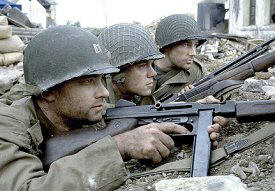 Now, maybe this didn’t occur to him, but a contemporary film
parroting the empty myth of America saving the world for democracy
all by itself in WWII would be fairly critic proof. Steven Spielberg
is no dummy. He correctly foresaw the USA was becoming more
conservative, so why not play into that and make a war film just
like the ones he saw in his youth?
Now, maybe this didn’t occur to him, but a contemporary film
parroting the empty myth of America saving the world for democracy
all by itself in WWII would be fairly critic proof. Steven Spielberg
is no dummy. He correctly foresaw the USA was becoming more
conservative, so why not play into that and make a war film just
like the ones he saw in his youth? 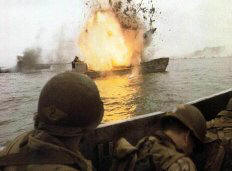 Considering accuracy, does Spielberg even get the facts of Omaha
Beach right? Did you get any sense that Omaha Beach was really ten
kilometers wide? I didn’t. The real plan for Omaha was for the
troops to secure the beach and then have bulldozers knock down the
sea wall. Tanks would then blast through German fortifications and
then the men would follow the tanks. What really happened was that
the water and tides were unexpectedly strong and the men were washed
completely off course. Virtually no unit landed where they were
supposed to. That’s why they landed directly in front of enfilading
German machine gun fire; they certainly weren’t heading there on
purpose.
Considering accuracy, does Spielberg even get the facts of Omaha
Beach right? Did you get any sense that Omaha Beach was really ten
kilometers wide? I didn’t. The real plan for Omaha was for the
troops to secure the beach and then have bulldozers knock down the
sea wall. Tanks would then blast through German fortifications and
then the men would follow the tanks. What really happened was that
the water and tides were unexpectedly strong and the men were washed
completely off course. Virtually no unit landed where they were
supposed to. That’s why they landed directly in front of enfilading
German machine gun fire; they certainly weren’t heading there on
purpose.  And regarding Steven Spielberg filming the “best” combat scenes
ever, that’s a rather a personal call don’t you think? While they
were riveting, I’d like to give a shout out to Francis Ford
Coppola’s Air Cavalry attack in Apocalypse Now; not to
mention the opening night battle in Brian De Palma’s Casualties
Of War. Any of the combat scenes in Richard Attenborough’s A
Bridge Too Far stand up well, along with other battle scenes
directed by everyone from Stanley Kubrick to Sam Fuller.
And regarding Steven Spielberg filming the “best” combat scenes
ever, that’s a rather a personal call don’t you think? While they
were riveting, I’d like to give a shout out to Francis Ford
Coppola’s Air Cavalry attack in Apocalypse Now; not to
mention the opening night battle in Brian De Palma’s Casualties
Of War. Any of the combat scenes in Richard Attenborough’s A
Bridge Too Far stand up well, along with other battle scenes
directed by everyone from Stanley Kubrick to Sam Fuller.