In Remembrance: Artie Shaw
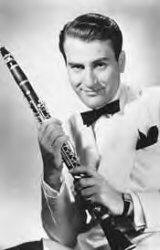 Artie Shaw, the swing era band leader and clarinetist whose biggest hit was
a rendition of Cole Porter’s “Begin the Beguine”, has passed away on
Thursday, December 30, 2004 in Thousand Oaks, California. He was 94.
Artie Shaw, the swing era band leader and clarinetist whose biggest hit was
a rendition of Cole Porter’s “Begin the Beguine”, has passed away on
Thursday, December 30, 2004 in Thousand Oaks, California. He was 94.
Born Arthur Jacob Arshawsky on May 23, 1910 in New York City, his parents were immigrants who worked in the garment industry. Growing up in New Haven, he bought a saxophone at age 13 and taught himself to play. By 16 he was playing professionally. He later switched to clarinet in order to land a job. By his early 20s, Shaw was playing in a CBS radio orchestra.
In 1935, Shaw composed “Interlude In B Flat” which premiered at New York’s Imperial Theatre. A piece which featured Shaw’s clarinet set against a string quartet and rhtym section drew rave reviews, but did not to well commercially. Shaw then formed a more traditional swing big band. The group released “Begin The Beguine” in 1938 and the song quickly rocketed up the charts, staying a number 1 hit for six weeks. Other hits for Shaw included “Dancing in the Dark,” “Nightmare,” “Accent-tchu-ate the Positive,” “Moonglow,” and “Stardust.”
Shaw was constantly dissolving and reforming his band in various combinations. Throughout the 30s and 40s such notable musicians as Buddy Rich, Mel Torme, Ray Conniff, Roy Eldridge and “Hot Lips” Page all had played in at least one incarnation of his band. Shaw was also the first orchestra leader to have both white and black musicians together in his orchestras, starting with the hiring of singer Billie Holiday in 1938. At the height of his popularity he was earning approximately $60,000.00 a week.
In 1939, Shaw and his orchestra made three ten minute musical shorts for Warner Brothers. The first, entitled simply Artie Shaw and His Orchestra, featured the songs “Nightmare”, “Begin The Beguine”, “Let’s Stop The Clock”, “Non-Stop Flight” and “Prosschai.” The second, Symphony Of Swing for Warner Brothers, which featured the group performing the tunes “Jeepers Creepers”, “Deep Purple” and “Lady Be Good.” Both shorts featured vocal performances by Tony Pastor and Helen Forrest. The third, Artie Shaw’s Class In Swing, featured Shaw giving a tutorial on what constitutes swing-style music.
Shaw and his orchestra also appeared in the 1939 Metro-Goldwyn-Mayer film Dancing Co-Ed, which starred Lana Turner. Shaw and Turner married on February 13, 1940 but divorced the following September. Turner was the third of Shaw’s eventual eight wives.
In 1940, Shaw appeared in the Fred Astaire/ Paulette Goddard musical comedy Second Chorus for Paramount Pictures. Shaw would receive two Academy Award nominations for the film- for Best Score and for Best Song, “Love Of My Life” co-written with Johnny Mercer.
Shaw was plagued by a perfectionist streak that only grew worse the better his playing and composing got. He was also growing more upset with audiences who wanted to hear his familiar dance hits and were less receptive to his more experimental compositions. Finally, in 1954, he put away his clarinet and never played it again. Over the ensuing years he turned his attentions to writing his autobiography The Trouble With Cinderella and the short story collections I Love You, I Hate You, Now Drop Dead! and The Best Of Intentions.
In 1983, he returned to music to organize a new Big Band bearing his name. The group was lead by clarinetist Dick Johnson, with Shaw only acting as host for the concerts and occasionally conducting the opening number “Nightmare.” The group revitalized interest in Shaw and his music and he soon became the subject of the 1985 documentary Artie Shaw: Time Is All You Got from director Brigitte Berman.
Shaw’s compositions and arrangements remain so well known that they are still used to evoke that time period in films such as Radio Days (1987) and The Aviator (2004).