In Remembrance: Conrad L. Hall
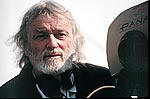 Conrad Hall, noted cinematographer who won two Academy Awards for his work on
Butch Cassidy and the Sundance Kid and American Beauty, passed away
on Saturday, January 6,2003 of complications from bladder cancer. He was 76.
Conrad Hall, noted cinematographer who won two Academy Awards for his work on
Butch Cassidy and the Sundance Kid and American Beauty, passed away
on Saturday, January 6,2003 of complications from bladder cancer. He was 76.
Hall was born on the family estate in Papeete, Tahiti in 1926 to James Norman Hall, co-author of Mutiny on the Bounty and Botany Bay. He initially planned on following in his father’s footsteps as a writer, but flunked out of journalism school at the University of Southern California. After flipping through a course selection book, he choose “cinema” as a course of study.
Following graduation, and inspired by department chairman Slavko Vorkapich, Hall tried his hand at independent filmmaking with the experimental picture Sea Theme. With several fellow students, Hall created Canyon Films, though few of the company's projects received widespread theatrical play. He also worked as a cameraman on several installments of Disney’s “True Life Adventures” features. He earned his first credit as a cinematographer in 1962 on the series Stoney Burke. He also shot such classic Outer Limits episodes as “Man Who Was Never Born” “The Bellero Shield” “The Architects of Fear” and “Do Not Open Till Doomsday”.
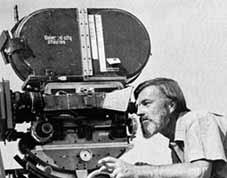 Hall moved over to films full time in 1965, working on the spy thriller
Morituri, which would earn him his first Academy Award nomination and the
Esperanto language film Incubus (Written and directed by Stoney Brooks
and Outer Limits producer Leslie Stevens).
Hall moved over to films full time in 1965, working on the spy thriller
Morituri, which would earn him his first Academy Award nomination and the
Esperanto language film Incubus (Written and directed by Stoney Brooks
and Outer Limits producer Leslie Stevens).
Hall preferred to shoot in black and white and his work on In Cold Blood (1967) is perhaps the best work done in the twilight years of black and white filming. However, when working in color on films like Harper (1966) and Cool Hand Luke (1967), Hall often eschewed the artificial-looking, “Hollywood” lighting, favoring more naturalistic lighting. After 1976’s Marathon Man, Hall left to film business to open a commercial production house with Haskell Wexler.
Upon returning to films with 1987’s Black Widow, Hall embarked on a productive decade, lensing on diverse projects from the thriller Jennifer Eight (1992) to the dark comedy American Beauty (1999). His last film was noirish Irish mob drama The Road To Perdition (2002).
In addition to winning his two Academy
Awards films, Hall was nominated for his work on seven others- A Civil Action
(1998), Searching For Bobby Fischer (1993), Tequila Sunrise
(1988), Day of the Locust (1975), In Cold Blood (1967), The
Professionals (1966) and Morituri (1965).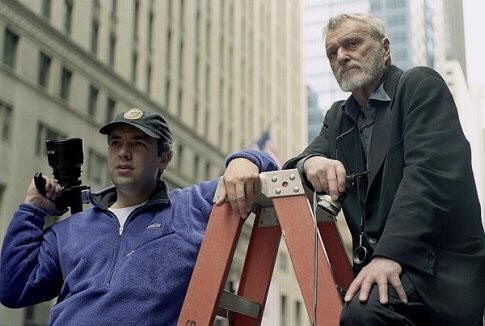
He has received Lifetime Achievement Awards from The LA Film Critics Association, The National Board of Review, Camera image and the American Society of Cinematographers. In addition he was awarded outstanding achievement awards from the ASC for American Beauty, Love Affair (1994), Searching for Bobby Fischer and Tequila Sunrise.
He has won two British Academy Awards for American Beauty and Butch Cassidy and the Sundance Kid and the top award from the British Society of Cinematographers for American Beauty and Marathon Man .
At the time of his death he was serving as the Kodak Cinematographer in residence at the University of California, Los Angeles School of Theatre Film and Television. He was also reportedly preparing to make his directorial debut with a comedy about a gigolo going through a mid-life crisis.
In a quote to the Associated Press producer Richard Zanuck said, “Every film that Hall worked on was something beautiful to the eye and very imaginative.”