In Remembrance: Sir Peter Ustinov
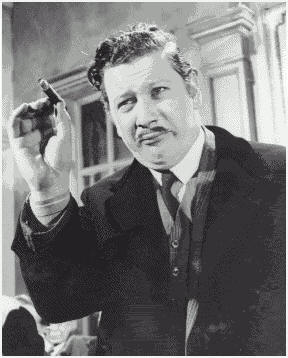 Sir Peter Ustinov, two-time Oscar winner and one of the greatest character
actors of all time, passed away March 28th,, 2004. He was 82.
Sir Peter Ustinov, two-time Oscar winner and one of the greatest character
actors of all time, passed away March 28th,, 2004. He was 82.
Ustinov was born on April 16, 1921 in London, England, the only son of a Russian artist mother and a journalist father. He began acting at age 17, and sold his first screenplay at age 24, 1945’s The True Glory, and directed his first film School for Secrets (1946) at age 25.
His first onscreen role was as a priest in the British World War II film, One of Our Aircraft Is Missing (1942). Ustinov was able to show his versatility, speaking in Dutch and Latin as well as English. Although he had sparse appearances through the 1940’s, Ustinov kept himself busy as a screenwriter and director. His credits include 1944’s The Way Ahead, 1948’s comedy Vice Versa and 1949’s war comedy, Private Angelo.
Ustinov did not win the Oscar the first time he was nominated, for 1951’s Quo Vadis?, but did win the Golden Globe for his portrayal as the amoral Roman emperor Nero. As the Prince of Wales, Ustinov was a stellar player over Stewart Granger and Elizabeth Taylor in the period movie, Beau Brummel (1954). Likewise, he shined with Humphrey Bogart and Aldo Ray as the role of Jules, in the Michael Curtiz directed 1955 comedy, We’re No Angels.
Ustinov would win the first of his two Best Supporting Actor Oscars as the owner of the gladiator school in Stanley Kubrick’s Spartacus (1960). Audiences also saw Ustinov that same year with Deborah Kerr and Robert Mitchum in the rousing adventure film, The Sundowners. He was nominated for a Director’s Guild of America Award for direction for 1961’s intelligent Cold War satire Romanoff and Juliet, for which he also wrote and starred. In 1962, Ustinov shined again with Oscar caliber direction and top-notch acting in the superb adventurous sea-epic, Billy Budd. The Academy overlooked his work, but he was nominated for a Director’s Guild of America Award for direction and a BAFTA for his screenplay. Star Terrence Stamp received a Best Actor Oscar nomination. Ustinov made film news headlines in early 1963 after he backed out of The Pink Panther and was replaced by Peter Sellers. Ustinov’s second Oscar as Best Supporting Actor came in the Jules Dassin directed jewel heist comedy, Topkapi (1964). His screenwriting earned him a Best Original Screenplay Oscar nomination for 1968’s Hot Millions.
During the 1970’s, Ustinov continued to make an impression in the film world. He is remembered for directing the 1972 Richard Burton/Elizabeth Taylor film Hammersmith Is Out. Also, he had offered his voice talent to the characters of Prince John and King Richard in Disney’s 1973 animated feature Robin Hood. But, Ustinov’s most memorable role of the 1970’s was as the Old Man in the memorable 1977 sci-fi film, Logan’s Run.
Ustinov began the 1980’s playing the role of Charlie Chan in Charlie Chan and the Curse of the Dragon Queen (1981) and made an appearance as a truck driver in Jim Henson’s The Great Muppet Caper (1981). Ustinov is well remembered in the 1980’s by Agatha Christie fans by portraying detective Hercule Poirot in five films on the big screen and TV. He starred as the detective in the 1978 film Death on the Nile, but excelled in the role in Evil Under the Sun (1982), the 1985 made-for-television movie Thirteen at Dinner and 1988’s feature film Appointment with Death.
In 1990 when he was knighted Sir Peter Ustinov. One of his last great onscreen roles was the doctor in 1992’s Lorenzo’s Oil. However, he focused more on roles in television films, including 1999’s Alice in Wonderland and Animal Farm. His last onscreen role was in 2003’s critically acclaimed historical drama, Luther.
Ustinov won three Emmy Awards during his career. He won in 1957, for an Omnibus drama on Samuel Johnson; 1966, for his performance as Socrates in Barefoot in Athens, and 1970, for A Storm in Summer. He also won a Grammy for his narration of Tchaikovsky’s “Peter and The Wolf”. Ustinov also wrote and directed various plays.
Ustinov acted also as a humanitarian and goodwill ambassador of UNICEF from 1968 until his death in 2004. He will be remembered for leaving behind a great film history for generations to discover.
-John Gibbon