|
In Remembrance: Richard Pryor
Born on December 1, 1940 in Peoria, Illinois, Pryor claimed to have grown up in a brothel run by his grandmother. He got his first taste of performing, when at the age of 7 he began playing drums at a local nightclub. After dropping out of high school, Pryor served a two-year stint in the Army before turning to standup comedy. Through the 1960s Pryor worked at perfecting his own comic voice- a style which mixed off-color language with sharp social observations. Pryor’s standup career is documented in the four concert films Richard Pryor: Live In Concert (1979), Richard Pryor Live On The Sunset Strip (1982), Richard Pryor Here And Now (1983) and Richard Pryor: Live And Smokin’ (1985) and in appearances in the films Dynamite Chicken (1972) and Wattstax (1973). Pryor’s first acting role was in the Sid Caesar comedy The Busy Body (1967). Although concentrating on his standup career, Pryor still made time to appear in small roles in such films as Wild In The Streets (1968), Lady Sings The Blues (1972), The Mack (11973) and Uptown Saturday Night (1974). When Mel Brooks was developing the western movie satire Blazing Saddles (1974), he initially envisioned Pryor in the role of Bart, the black sheriff sent to protect a frontier town full of bigots from a dastardly railroad tycoon. Brooks extended an offer to Pryor to help with the writing of the film along with the screenplay’s originator Andrew Bergman and Norman Steinberg and Alan Uger. During the writing sessions, Pryor gravitated towards the character of Mongo (Alex Karras), the hulking, dimwitted henchman of the villain, writing most of the material for the character. Brooks reports that it was Pryor who wrote the character’s classic line “Mongo only pawn in game of life.” Unfortunately, despite his Brooks’ insistence that Pryor was on the verge of stardom, the executives at Warner Brothers, the studio had concerns about Pryor’s reliability and refused Brooks permission to hire Pryor for the lead. Pryor would rebound and go on to be featured in several supporting roles in such comedies as Car Wash (1976), Blue Collar, The Wiz (both 1978) and Wholly Moses! (1980). In 1976 Pryor appeared in Silver Streak, a Hitchcockian comic thriller starring Gene Wilder. Although Pryor only appears in the second half of the film with Wilder, their on-screen chemistry was the highlight of the film. The two would re-team in 1980 for the hit comedy Stir Crazy. Unfortunately, their two subsequent pairings – See No Evil, Hear No Evil (1989) and Another You (1991) – were not critically well received. Pryor’s first major headlining role was in the comedy Which Way Is Up? (1977), in which he played three roles. For the bio-pic Greased Lightening, Pryor starred as Wendell Scott, the first black NASCAR driver. However, leading roles where few for Pryor and he frequently found himself doing supporting work in films such as California Suite (1978) and In God We Tru$t (1980). In June 1980, Pryor attempted suicide by setting himself on fire while high on drugs. At the time his management would describe the incident as an accident while Pryor was freebasing cocaine. After 16 months of hospitalization and therapy, Pryor returned to the standup stage, making the incident the centerpiece of his performance film Richard Pryor Live On The Sunset Strip (1982). Pryor further mined the incident for the autobiographical Jo Jo Dancer, Your Life Is Calling (1986), which Pryor co-wrote, produced and directed. Through the 1980s, the quality of Pryor’s film work dipped, as evidenced by appearances in such lackluster movies as The Toy (1982), Superman III (1983), Critical Condition (1987), Moving (1988) and Harlem Nights (1989). In 1986, Pryor announced that he had been diagnosed with multiple sclerosis and spent the next several years slowly withdrawing from the public eye. He gave his last standup performances in 1992. In 1995 he appeared on the television medical drama Chicago Hope, earning an Emmy Award nomination for his turn as an embittered MS victim. Pryor’s last film appearance was a small role in David Lynch’s Lost Highway (1997). |
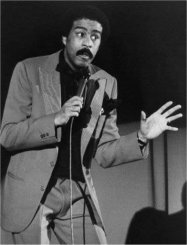 Richard Pryor, the groundbreaking comic who became a major comedy
film star in the 1970s and `80s, has passed away on December 10,
2005 in Encino, California. He was 65.
Richard Pryor, the groundbreaking comic who became a major comedy
film star in the 1970s and `80s, has passed away on December 10,
2005 in Encino, California. He was 65.