Early, Racier Version of Stanwyck’s Baby Face Discovered
By Rich Drees
 A racier, pre-release version of Baby Face (1933), already
one of the most notorious of all the films of Hollywood’s Pre-Code
era, has recently been discovered in the Library of Congress’s film
archives.
A racier, pre-release version of Baby Face (1933), already
one of the most notorious of all the films of Hollywood’s Pre-Code
era, has recently been discovered in the Library of Congress’s film
archives.
Baby Face starred Barbara Stanwyck as Lily, a woman whose abusive father (Robert Barrat) forces her into prostitution in a seedy Erie, Pennsylvania speakeasy. After his death, Lily heads to Manhattan for a better life, getting in it the only way she knows how- using and casting aside an increasingly wealthy string of men. (A young John Wayne is an early conquest.) When being interviewed for a job, Stanwyck is asked, “Have you had any experience?” to which she rolls her eyes and snarls “Plenty.” Her actions bring about her eventual downfall but not before she leaves a broken engagement and a murder/suicide in her wake. The film was produced by Warner Brothers Studios, who made a specialty of producing dramas that cast light on the grittier side of life.
The new version was discovered last summer by Mike Mashon, curator at the Motion Picture Division of the Library of Congress. When a new print was requested to be struck for London Film Festival organizers from the film’s original camera negative, it was discovered that the Library also held an additional dupe negative of the film which technicians reported to be five minutes longer than the version that had been in circulation since 1933. Upon screening this new version, Mashon realized that this longer version contained many racier scenes that were eventually toned down for release.
Since no standardized ratings system existed at the time, every film
was screened by state and often also local film boards who would
rule whether or not it was
acceptable to be screened for the public. When Warners submitted
Baby Face to the New York State Board of Censors, it was
rejected for its frank subject matter on April 28, 1933. Since New
York City was a financially important market, the studio reworked
the film into a more acceptable form. The modified version was
released in July 1933.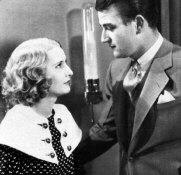
The changes made to the film are almost instantly obvious. In one of the opening scenes, Lily, described rather suggestively by one of the speakeasy patrons as “the sweetheart of the night shift”, is sold to a sleazy local politician by her father. A wad of money changes hands, the politico leers at Lily only to have his advances repeatedly rebuffed first with hot coffee in his lap and finally with a beer bottle to the forehead. In the release version, no money is exchanged and Lily doesn’t smash a beer bottle over the politician’s skull.
Sometimes it would only take the removal of a line to change the tone of a scene. For example, early in the film Lily has an argument with her father and states, “Yeah, I'm a tramp and who's to blame? My father! A swell start you gave me! Nothing but men! Dirty, rotten men – and you're lower than all of them!” However, the original version of the film contained an extra, more explicit line- “A swell start you gave me! Ever since I was 14! Nothing but men!”
But the judicial trimming of shots wasn’t the only thing done to make the film acceptable. Many scenes were shot with modified dialogue.
After her father’s death, Lily is inspired by the local cobbler Cragg (Alphonse Ethier) to seek her fortunes in Manhattan. In the original version, he advises her to continue what she was forced to do by her father, but this time for her own gain. “A woman, young, beautiful, like you can get anything she wants in the world because you have power over men,” he tells her. “But you must use men, not let them use you. You must be a master, not a slave. Exploit yourself. Go to some big city where you will find opportunities. Use men to get things you want.”
The scene was modified by Warners to not only remove the salacious tone, but also to put a different moral spin on it. Cragg now counseled “A woman, young beautiful, like you can get anything she want in the world, but there is a right and a wrong way. Remember the price of the wrong way is much too great. Go to some big city where you will find opportunities. Don’t let people mislead you. You must be a master, not a slave. Be clean. Be strong, defiant. And you will be a success.”
A new coda was also added to the film. Initially Baby Face ended on a somewhat ambiguous note. Lily’s bank president husband (George Brent) attempts suicide after she refuses to give him much needed money after being given every luxury she has asked for. For the released version, a new scene was tacked on wherein two characters are discussing Lily and her husband’s fate. It is revealed that he has recovered and has taken a job as a laborer in a Pittsburgh steel mill. The couple is poor but “working out their happiness together.”
 Even though the film passed the New York censors on June 17 and went
on to be a moderate success for the studio, it still became one of
many movies to fall under criticism from conservative groups
decrying a perceived moral decline in Hollywood films. Under threat
of government intervention, the major Hollywood studios joined
together to adopt the Production Code in 1934, which laid out strict
guidelines for films and their moral content.
Even though the film passed the New York censors on June 17 and went
on to be a moderate success for the studio, it still became one of
many movies to fall under criticism from conservative groups
decrying a perceived moral decline in Hollywood films. Under threat
of government intervention, the major Hollywood studios joined
together to adopt the Production Code in 1934, which laid out strict
guidelines for films and their moral content.
This is not the first incident where a pre-release version of a classic Hollywood film has been discovered. Pre-release versions of the Humphrey Bogart-Lauren Bacall mystery The Big Sleep (1946) and the John Ford western My Darling Clementine (1946) have been discovered and released on DVD.
The pre-release version of Baby Face premiered at the London Film Festival and had its American premier at New York’s Film Forum on January 24, 2005 and is currently making the round of revival and archival theatres around the country. A DVD release is expected in 2006.