Lost German Language
Laurel And Hardy Film Found
By John Gibbon
 On August 9th, historians at the Munich Film Museum announced a
long lost copy of Stan Laurel and Oliver Hardy’s early sound work was
discovered while searching a film archive in Moscow.
On August 9th, historians at the Munich Film Museum announced a
long lost copy of Stan Laurel and Oliver Hardy’s early sound work was
discovered while searching a film archive in Moscow.
According to those who made the find, a 1931 film in which the comedy duo performed entirely in German, Spuk um Mitternacht (Ghost at Midnight), is spliced together from two other short films, Berth Marks (1929) and The Laurel-Hardy Murder Case (1930).
 |
|
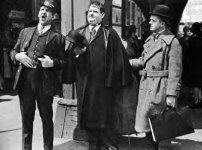
Laurel and Hardy (with S. D. Wilcox) in Berth Marks (1929). |
Berth Marks is movie history as it is the first Laurel and Hardy short with sound. It stars the pair as a vaudeville act due to play a show in Pottsville. After boarding a train, armed with a fiddle, they’re victims to countless ridiculous mishaps, but finally arrive in Pottsville. However, as the train leaves they realize the fiddle is still aboard. In The Laurel-Hardy Murder Case, Hardy reads a newspaper advertisement about heirs to the late Ebenezer Laurel. He convinces Laurel of the $1, 000, 000 inheritance and they both set off to the Laurel mansion, where they discover other claimants, a murder investigation and a ghost!
Until the movie was found in July, the only German-speaking piece featuring the two Hollywood stars was a trailer from a German version of their 1931 film Hinter Schloss und Riegel (Pardon Us). All other German ‘phonic’ versions from the early 30s were thought to be lost.
"Because dubbing was still difficult at the start of the sound era, [films] were shot in various languages," a spokesman for the museum said. The silver screen relic is from the early years of Hollywood when many famous stars such as Greta Garbo and Buster Keaton would dub their films in various languages to reach a world audience. However most of those films have been lost.
Stan Laurel and Oliver Hardy spoke phonetically in German with the help of speech coaches and cue cards, while native speakers replaced the original supporting cast. Laurel and Hardy remade several of their shorts for foreign audiences in Spanish, French and even Italian.
The movie was advertised as Laurel and Hardy's first German motion picture
with sound, premiering in Berlin on May 5th 1931, complete with a
visit by the comedic pair, and proved to be a big success. Billed as “Dick
und Doof” (“Fat and Dumb”) in Germany, the mismatched pair was immensely
popular in Germany and Europe, more so than the United States.

Oliver Hardy once tried to explain why audiences enjoyed their antics, saying, “Those two fellows we created, they were nice, very nice people. They never get anywhere because they are both so dumb, but they don’t know they’re dumb. One of the reasons people like us, I guess, is because they feel superior to us”.
Hardy (then known as Babe Hardy) first appeared with Laurel in a 1917 short film called Lucky Dog. Later, in the mid-20’s Laurel went on to direct movies at Hal Roach Studios, with Hardy in the cast. With a bit of help from Hal Roach director Leo McCarey (Going My Way, 1944), Laurel and Hardy first came together onscreen in 1926. Within a year from their first dual performance, they were being touted as a new comedy team. They were surprisingly cut out for one another: the childlike dim-bulb Laurel repeatedly took the abuse of the round-faced and bossy Hardy. They worked in many silent films and easily progressed to talkies. Their success quickly spread across the globe and they made more than a 100 films together, once winning an Oscar for the short-film The Music Box (1932).
The rediscovered print of Spuk um Mitternacht was shown in Bonn as part of the Bonn Silent Film Festival on August 14th. About ten minutes are missing from the print found in the Russian film archive but includes jokes written specifically for a German audience. The museum's director, Stefan Droessler, told news sources, "In general the film works very well even in this little short version and contains all the unique jokes about Stan's uncle in Berlin and Julius Caesar.” The missing scenes were replaced with corresponding footage from the American and the Spanish versions. The newly discovered print is damaged: a thick vertical line is all too present and isn’t likely to disappear with digital film restoration.
The film is intended to be further restored to its full length for two special screenings at the Munich Film Museum on October 26th and 27th and a future DVD release.
However, it’s the language of Spuk um Mitternacht providing the main sensation. As Wolfgang Guenther, director of the Laurel and Hardy Museum in Solingen, Germany states, “They had a little German in their heads. Their German is really broken. That’s the laugh effect. They didn’t know German at all.”