12th Annual Philadelphia Film Festival
Part 2
By Rich Drees
800 Bullets (2002, Spain)
A shear delight from start to finish, 800 Bullets is a loving and often funny homage to the spaghetti westerns of the 60s that propelled Clint Eastwood to stardom.
Young Carlos runs away from his career engrossed mother to find his grandfather Julian who is working in a run down Hollywood-Wild West tourist park as head of the park’s stunt show. Julian’s glory days as a stunt man in the spaghetti westerns that filmed in the area. When Carlos’ mother finally tracks him down, she seizes the opportunity to buy the tourist park to tear it down- in part for the land’s real estate value but mostly to hurt Julian. When the actors of the stunt show learn of their fate, they decide to stand up and fight.
800 Bullets is a story about family. Julian is the head of the family like group of performers, while Carlos is looking for a family that will pay some attention to him. Fortunately, though, De La Iglesia doesn’t get sentimental and batter the audience over the head with this theme. Instead, he let’s the film unspool at a deliriously fun pace.
This was my first encounter with De La Iglesia’s work and I am eager to track down his other films. There is an energy to his direction that recalls Sam Raimi’s work. Much like Raimi’s period-set homage to the spaghetti western The Quick and the Dead, 800 Bullets has taken the genre conventions and filters them through a modern sensibility.
Bollywood/Hollywood (2002, Canada)
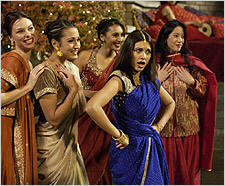 Along with 800 Bullets, Hollywood/Bollywood is one of the two
films I saw at the Festival that I can’t wait to show to friends. A
hilarious romantic comedy, Bollywood/Hollywood follows first
generation Canadian Rahul (Rahul Khanna) as he tries to find love for
himself without alienating his steeped in Indian tradition mother.
Along with 800 Bullets, Hollywood/Bollywood is one of the two
films I saw at the Festival that I can’t wait to show to friends. A
hilarious romantic comedy, Bollywood/Hollywood follows first
generation Canadian Rahul (Rahul Khanna) as he tries to find love for
himself without alienating his steeped in Indian tradition mother.
The movie opens with Rahul promising his father on his deathbed to marry an Indian girl. Ten years later finds Rahul a successful young businessman involved with a decidedly non-Indian pop star (Jessica Pare). When she is killed in a tragic meditation levitation accident, Rahul’s mother delivers the ultimatum that he must become engaged to an Indian girl before his already engaged sister can be married. Despondent, he hires a girl he meets in a bar (Lisa Ray) to play the part so his sister can get married.
Unlike the recent Bend It Like Beckham, Bollywood/Hollywood is driven more by its characters rather than any clash of cultures. Sure, the story is a riff of Pretty Woman, but redone with a distinct Bollywood sensibility. Like in most Bollywood fare, people break out into song and dance routines at the drop of a hat. But while this film embraces the conventions of Bollywood films, it never really spoofs them. Instead Bollywood/Hollywood comes off as a Bollywood version of a Hollywood romantic comedy that just happens to be shot in English.
The Eye (2002, Hong Kong/ Thailand/ Great Britain)
Following their impressive debut film Bangkok Dangerous (1999) the Pang Brothers, Danny and Oxide, return with their exceptionally creepy supernatural thriller, The Eye.
 When blind musician Mun receives a corneal transplant she discovers that she
now has more than just normal vision- she can now see the spirits of the
departed as well as dark, vague shapes who seem to be harbingers of death.
When blind musician Mun receives a corneal transplant she discovers that she
now has more than just normal vision- she can now see the spirits of the
departed as well as dark, vague shapes who seem to be harbingers of death.
The Eye has
been compared to M. Night Shamalin’s The Sixth Sense, but it is only
a superficial comparison. While both films rely on mood to generate anxiety
in the viewer, Mun’s search for her corneas’ donor feels more akin to the
heroine of Ringu’s search for the origin of that film’s cursed video.
The few genuinely creepy moments, like the climactic scene in the traffic
jam, rely on the momentum of the mounting tension rather than shock to
affect the audience.
Rub and Tug (Canada, 2002)
Politics in the work place is nothing new, but Rub and Tug may be the first time it’s been explored in the shady environment of a Toronto message parlor.
Conrad has just been hired as the new manager of a message parlor. The owner warns him that the three girls are not supposed to perform “full service” on the clients. The girls, Cindy, Lea and Betty, know that they can bigger tips if they deliver a little more than just a rub down to customers. The girls all have their own plans and decide to use various methods to influence Conrad for their own gain.
Much like how the masseurs are supposed to perform their job, Rub and Tug teases us with the prospect of being a funny, biting comedy but fails to deliver the goods. The film starts to get mired down about midway through, when comic ideas are followed to their dramatic, not comedic, conclusions and at least one storyline gets completely abandoned. The film’s climax (forgive the pun) continues the downward spiral. The revenge that the wronged parties mount would be rather easy to defeat and everyone’s happy endings rely too much on coincidence.