2004 Philadelphia Film Festival Review
Part 1
By Rich Drees
Some people think of Philadelphia and associate everything from cheesesteaks to the signing of the Declaration of Independence. But for some, the City of Brotherly Love is synonymous with the annual Philadelphia Film Festival, one of the premier festivals on the East Coast. Here’s just a sample of some of the films screened this year-
 You
Can’t Stop The Murders
(Australia, 2003)
You
Can’t Stop The Murders
(Australia, 2003)
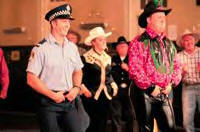
A serial killer who bases his crimes on the 70s disco sensation The Village People is the subject of this hilarious comedy from Australia. Gary (Gary Eck) and Akmal (Akmal Saleh) are police constables in the sleepy costal town of West Village (population 350) trying to solve a series of grisly murders before the town’s annual “Fun Fest” and line dance competition. They are alternately helped and hindered by overly suave Tony Charles (director Anthony Mir), an Andy Garcia look-a-like police detective from Sydney whose sole police training seems to have been a steady diet of Dirty Harry movies. Eck, Mir and Saleh are big comedy stars in Australia and though this is my first exposure to them, I can see why. The trio earn their laughs effortlessly and naturally. They’ve been compared to Jim Carey, which I think is a disservice to them, as their performances are so natural, eschewing any type of Carey-style camera mugging. All of this comes from the script’s carefully created characters. Gary’s heartbreak over the object of his affections, local news reporter Julia (Kirstie Hutton) decision to spend the night with Tony create an extra lawyer of laughs when intercut with Tony and Julia’s tryst, which is easily the funniest sex scene since Emma Thompson and Jeff Goldblum’s in The Tall Guy. The movie works as a murder mystery as well, with plenty of clues and red herrings to keep the audience guessing. The film maintains an excellent balance right up until the end with the final reveal of the killer being both funny and bittersweet. Here’s hoping that this will get a larger distribution in the United States outside of the festival circuit.
 Last Scene
(Japan, 2003)
Last Scene
(Japan, 2003)
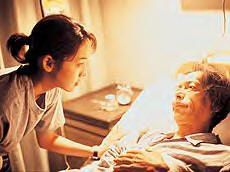
Director Hideo Nakata switches focus from horror (Ringu, Dark Water) to a melancholy character study with his latest film, Last Scene. In the mid-60s, Mihara (Hidetoshi Nishijima) had it all, a rising acting career and a beautiful wife. However, when his frequent co-star decides to get married and retire, studio executives stop giving him plum assignments. His own egotism and a slid towards alcoholism brand him a troublemaker, but he finally gives up acting after his wife is killed in a car accident. Thirty-five years later, he returns to his old studio to perform one last small role in a medical drama and perhaps searching for a quiet piece of dignity before he passes. Nakata has not completely forsaken the supernatural as Mihara talks to the ghost of his dead wife. Though the audience is left more with the impression that this is more that product of Mihara’s imagination than it is a real spectral visit. An air of melancholy pervades the film as Mihara spends time wandering the studio, noting changes, meeting technicians from the old days, seeing that his old dressing room has been converted to storage space. It feels that Nakata is also making comment on the state of the Japanese film industry, with crew people who are more concerned with anything but giving their best to the job at hand. It is only Mihara’s silent struggle to complete his scenes that inspires the older crew to at least, for one day of shooting, work like the did in their younger days.
 The Park
(Hong Kong, 2003)
The Park
(Hong Kong, 2003)
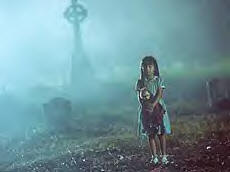
Although not billed as a comedy, this movie generates plenty of laughs, but
not in a good way. Bad acting and an illogical script that contains only one
good horror moment combine to form perhaps the most limp horror film in
recent memory. Fourteen years after witnessing the tragic death of a young
girl at an amusement park, Yen's brother Alan, is compelled to return to the
now abandoned park where he disappears. Yen (Bo Bo Chan) recruits a group of
friends to investigate, but soon after arriving their numbers begin dwindle.
By the time Yen yells at their unseen tormentors "Attack me but leave my
friends alone," it's far too late. Along the way director Andrew Lau pulls
out every horror film cliché from overly loud sound cues to the old "This
place was built over an old cemetery" chestnut to the seemingly current
vogue of creepy spectral children. Although billed as being partially in
3-D, there's less than 15 minutes of actual 3-D in the film's 91 minute run
time. Unfortunately, these three segments don't really utilize the potential
of 3-D at all, making it impossible to even recommend the film on the basis
of this gimmick. This is especially disheartening as there are shots in the
flat portion of the film that would have been more interesting in 3-D than
what is presented. After Andrew Lau's fantastic Infernal Affairs
films, The Park comes as an extreme disappointment.
 The Legend Of The
Evil Lake (South Korea, 2003)
The Legend Of The
Evil Lake (South Korea, 2003)
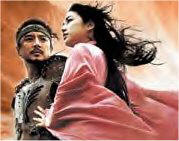
This fairly standard wuxia inspired film from South Korea has some nice locals and photography, but nothing else that really causes it to stand out. Gen. Bihrang (Jung Jun-ho) has rebuffed the advances of Queen Chinsong (Kim Hae-ri) in favor of the peasant girl Janubi (Kim Hyo-jin). While Bihrang is away at war, a rival general conspires to frame him as a traitor so as to win the Queen for himself. While fleeing from the general’s murderous agents, Janubi accidentally frees and is taken over by an evil sorcerer whose spirit was imprisoned in a lake by the Queen's forefather nine and a half centuries ago. The script is barebones with a majority of the second half of the film features the characters just running after each other screaming their names. The action is serviceable but lacks any real punch with the exception of a few moments of gore that seem uncharacteristic for the normally more conservative Korean film industry.