14th Annual Philadelphia Film Festival
By Rich Drees
 Survive Style
5+ (Japan)
Survive Style
5+ (Japan)
What do a London hit man who opens all his conversations with “What is your function in life?,” an advertising executive re-examining her life, a trio of young house burglers, a businessman who has been hypnotized into believing he is a bird and a man who is having trouble keeping his murdered wife dead all have in a common? In Survive Style 5+, not very much, as these five separate storylines only briefly and lightly brush against each other. To describe any more of the film’s plots would be to spoil too many surprises, and this is a film where half the enjoyment stems from the almost non-sequitur twists the narratives are prone to take. Credit should be given to first time director Gen Sekiguchi who balances all the plot threads deftly, weaving them into a highly entertaining whole where a lesser director could easily have failed. With a background in commercials, Sekiguchi brings a visual flair in both camera work and eye-popping production design that never overwhelms the material. An outstanding debut that must be seen to be believed.
 Swindled
(Spain)
Swindled
(Spain)
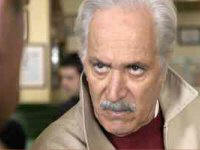
A real estate scam is at the heart of its plot, Swindled is a film that ultimately leaves the audience trying to guess who is conning whom. Ernesto (Ernesto Alterio) is a small time crook who has worked his way up the con game ladder until he is working with Frederico (Frederico Luppi), known as the King of Conmen. Together, the two begin to orchestrate a real estate con that would earn them millions. Things become complicated when Frederico’s ex-lover, Pilar (Victoria Abril), is brought into the plan. Soon, Frederico begins ignoring his own rules about running a successful con and a member of the con team is found dead. As in all good caper films, the final act is filled with plenty of twists and reversals, a majority of which succeed in surprising the audience. However, there’s nothing that kicks the material up a notch from well constructed and entertaining to outstanding.
 The
Lakeside Murder Case
(Japan)
The
Lakeside Murder Case
(Japan)
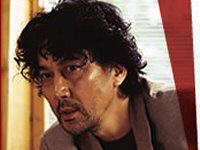
All parents want their children to succeed, but how far will they go to ensure that they do? That’s the question ultimately posed by the Japanese murder mystery The Lakeside Murder Case. On a secluded education retreat intended to prepare their children for a prestigious school’s rigorous entrance exam, three couples find themselves inextricably bound together in covering up a murder. In a fit of rage Misako has murdered Eisako, a co-worker of her husband Shunsake, with whom he was having an affair. Rather than have their children’s chances ruined by the crime, the parents decide to dispose of the body in the nearby lake. Although Eisako had arrived under the pretext of delivering some work materials to Shunsuke, he soon begins to suspect that she had more business at the retreat than just an illicit tryst with him. As Shunsuke investigates further, he discovers that all is definitely not as it seems, including Eisako, the other parents and their children’s tutor. The Lakeside Murder Case is an entertaining enough crime drama, with plenty of clues and red herrings to keep the audience guessing right along with Shunsuke. The movie is also critical of the Japanese culture’s strong drive for success and traditional social conformity. However, the film grinds to a halt right near the end when the characters seem to stop everything in order to debate this theme.
 Mana- Beyond Belief
(United States)
Mana- Beyond Belief
(United States)
We are told at the beginning of Mana- Beyond Belief that the Malaysian word mana is difficult to translate, though it roughly means the power one can instill in an object. Filmmakers Peter Friedman and Roger Manley then proceed to take us around the world to places and events that hold special meaning to various peoples. There is no narration or specific narrative through-line to the film. Instead, Mana is more of a meditation on how differing cultures revere different objects in their lives. Effective moments come when two events are contrasted, such as the quiet reverence of Burmese Buddhists at The Golden Boulder in Myanmarto and the much more festive atmosphere of a Japanese Cherry Blossom Festival. The film spends its middle third in the United States, taking a look at some of the things held sacred in America: the low-rider, Elvis Presley and the American flag. Mana also looks at how technology has impacted how people revere things. We are taken to Germany for the story of how the painting “Man With The Golden Helmet,” once thought to be one of Rembrandt’s crowning achievements, was proven to be painted by someone else. Though at one time the museum’s centerpiece attraction, drawing numerous visitors a day, the painting now hangs in a side gallery, unchanged but divested of its perceived importance, and all but ignored by passing museum patrons. Other sequences show representations of Buddha being festooned with LED lights to illustrate his radiance and a couple in Bangalore, India performing a blessing ceremony on their new home computer. Ultimately, Mana does such an effective job showing how people apply meaning to their surroundings that it just may generate some mana of its own.
 Checking Out
(United States)
Checking Out
(United States)
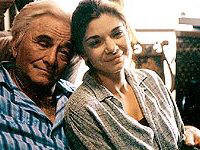
When ninety-year-old widower Morrie Applebaum (Peter Falk), retired Shakespearen actor, decides that he has had a good life and now wants a good death - a big farewell party culminating with his taking an overdose of sleeping pills - his three children (Laura San Giacomo, David Paymer and Judge Reinholdt) are naturally aghast. Such is the set-up of Checking Out, a fairly predictable comedy about dysfunctional family members learning to forgive each others’ foibles. The three children all have their quirks and neuroses, which drive much of the film’s attempts at humor. As one character so knowingly puts it, “It’s My Big Fat Jewish Funeral!” However, My Big Fat Greek Wedding succeeds in creating an entertaining and likeable ethnic family of characters, where Checking Out doesn’t. The leads struggle to bring energy to the flat material and for the most part do what they can. San Giacomo and Falk most notably create a convincing father-daughter chemistry on screen. Unfortunately, the film’s climax, in which every single character in the film discovers they share a common touchstone in Morrie’s past, exceeds any possible suspension of disbelief.