Ray
Reviewed by John Gibbon
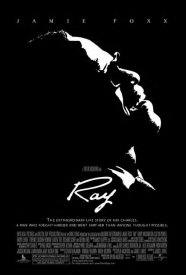 There is an old saying, “Imitation is the greatest form of flattery”. In the
remarkable new movie Ray, director Taylor Hackford and actor Jamie
Foxx have managed to redefine that very saying.
There is an old saying, “Imitation is the greatest form of flattery”. In the
remarkable new movie Ray, director Taylor Hackford and actor Jamie
Foxx have managed to redefine that very saying.
It’s truly a blessing that the movie came together after 15 years of trying, but Hackford seemingly has a magic ability to strike the right chord when it comes to portraying musicians on screen, a’ la Ritchie Valens in La Bamba and Chuck Berry in Hail! Hail! Rock and Roll. There is a sense of awe over Foxx’s physical resemblance – his every gesture emulates the head bobbing, herky-jerky movements of Ray Charles and the acting is so pure and passionate so well that he just doesn’t imitate, he becomes Ray.
It’s now a bit easier to forgive Foxx for his role in a movie titled Booty Call, as he is indeed securing his position in Hollywood as serious actor and possible Oscar nomination.
Early on in the film, the audience gets a taste of Charles’ charisma as he outwits a racist bus driver by declaring that he lost his eyesight as a result of a World War II skirmish. A teenaged Charles heads to Seattle and settles there, playing with his band and creating quite a stir locally. He soon falls victim to the tribulations and deceptions of the crooked music industry. But it’s his own growing itch for independence that fuels his desire to be a strong man, capable of making decisions and getting. He heads to the road, insisting on being paid in single bills so he’s not cheated. His music makes women swoon and he sizes them up by a touch of the wrist. Ray is a shrewd businessman, making records with the greatest of ease. He signs with the great recording tycoon Ahmet Ertegun (Curtis Armstrong, acting with the same energy he possessed in his early 80s movies) of Atlantic Records, and is taken by the sweet Della Bea (Kerry Armstrong). Charles finds marriage, but he also succumbs to the sins of the road, ingesting women and drugs into his life at every turn.
Ray
also expertly infuses the early childhood tragedies Charles underwent – the
death of his brother and his gradual loss of sight – as well-timed
flashbacks effective in illustrating what fueled his musical ambition and
unforgiving drug addiction. Key scenes involve his mother Aretha (Sharon
Warren, in her film debut), who educated him to “see” beyond the blindness
to reach his life goals.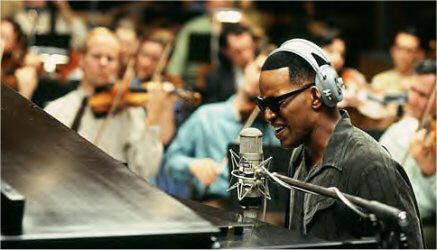
One of the many strengths of the movie is that the music is not invasive, like many movie soundtracks today, but nicely integrated to reflect the personality that was injected into Charles’ own artistry and the smooth timeline of his life. Hackford suggested Foxx lip-synch Charles words and rightfully so, because Charles had that uncanny ability to communicate that which defies definition in the music world. And the stories of the songs are just as delightful as the story of Charles. A few chuckles escaped over the creation of “Hit the Road Jack” and a kick-in-the-pants AHA! slipped out when Charles comes up with a song on the spot in one smart sequence.
The film successfully displays the many facets of his talent and his life; music and biography showcasing the uncommon quality and unique timelessness of Ray Charles. The only disappointment is the abrupt cut from 1966 to present Charles’ later years. However, Ray is a movie that slyly shows the world that Ray Charles recognized no boundaries. Just as he was “blind” to the limitations of musical genres – blending gospel, R&B and country together, he was also ignorant to differences of color (i.e. those of segregated America). At the same time, audiences get a picture of Charles’ blindness of his own problems centered on his drug habit and continual womanizing.
There is a sense of jaw-dropping admiration at what Charles accomplished and yet there is an unsettling sense of pity for a man who could not maintain overall control.
But Ray ultimately is an inimitable classic that lifts the heart and brings a tear to the eye, a film that demands to be seen as well as heard with open eyes.