Lord of the Rings: The Return of the King
Reviewed by Rich Drees
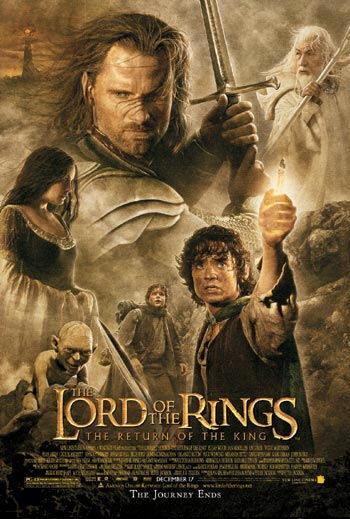 If you haven’t seen the first two Lord of the Rings films, you will
definitely need to go and rent them first before heading to the theatres for
the third and final installment, The Return of the King. Those of you
who have seen the first two installments should be told that you haven’t seen
anything yet.
If you haven’t seen the first two Lord of the Rings films, you will
definitely need to go and rent them first before heading to the theatres for
the third and final installment, The Return of the King. Those of you
who have seen the first two installments should be told that you haven’t seen
anything yet.
Although the orc armies of the evil wizard Saruman have been defeated, peace in Middle Earth is still far from secure. Frodo (Elijah Wood) and Sam (Sean Astin) are continuing their quest to journey into the heart of the enemy Sauron’s land to destroy the evil and powerful One Ring. Accompanying them is the treacherous Gollum (Andy Serkis), whom Frodo believes is redeemable but who is actually trying to drive a wedge of suspicion between the two old friends. Meanwhile Sauron has cast his attention towards Minas Tirith, capital of Gondor. Denethor (John Noble), the Steward of Gondor, refuses to believe the warnings of Gandalf (Ian McKellan) the wizard as the death of his son Boromir (Sean Bean, back in the series first installment The Fellowship of the Ring) has driven him to madness. It is up to Aragorn (Viggo Mortensen) to rally the last armies of men to keep Sauron’s attention occupied while Sam and Frodo attempt to fulfill their mission.
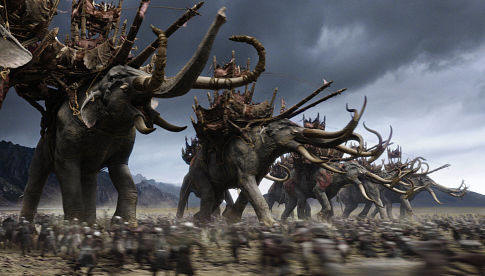 With this third film director Peter Jackson brings his epic, three-film
adaptation of J. R. R. Tolkien’s epic fantasy masterpiece The Lord of the
Rings to an end. And what an end it is. Return of the King features
grand action and epic battles between armies of tens of thousands. The
battles scenes achieve a scope hitherto unseen in any film, with the battle
outside of Minas Tirith making up a major portion of the middle of the film.
On one side is an army of men attempting to defend the city/fortress of
Minas Tirith. On the other is a seemingly endless army of orcs and trolls
armed with catapults, siege engines, battering rams and archers mounted atop
giant elephants.
With this third film director Peter Jackson brings his epic, three-film
adaptation of J. R. R. Tolkien’s epic fantasy masterpiece The Lord of the
Rings to an end. And what an end it is. Return of the King features
grand action and epic battles between armies of tens of thousands. The
battles scenes achieve a scope hitherto unseen in any film, with the battle
outside of Minas Tirith making up a major portion of the middle of the film.
On one side is an army of men attempting to defend the city/fortress of
Minas Tirith. On the other is a seemingly endless army of orcs and trolls
armed with catapults, siege engines, battering rams and archers mounted atop
giant elephants.
Yet amidst all the strung und dram, Jackson never loses sight of the
human element in these conflicts. All the main characters have moments where
they express doubt or fear over the events they are taking part in. The
testing of Frodo and Sam’s friendship on their journey forms one of the
movie’s emotional cores. And we are shown that war is not glorious. It is
brutal and even victories come with terrible personal prices for those
involved.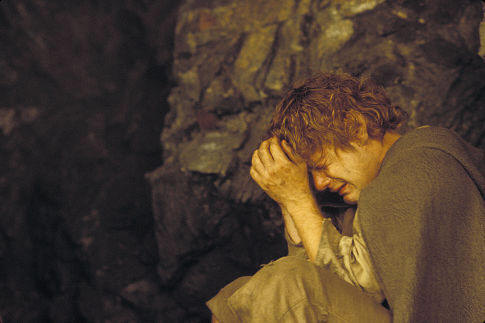
The cast provides performances of a caliber not usually found in genre films. Andy Serkis once again delivers a performance of the tortured Gollum that far exceeds the digital trickery that puts the creature on the screen. The true standout is Sean Astin who plumbs previously unseen depths to show Sam’s loyalty to his friend Frodo and the hurt and pain he feels as the Ring harms Frodo in ways that he is powerless to prevent.
Throughout the trilogy director Jackson has had the unenviable position of translating to screen concepts that Tolkien kept vague in his book. The ultimate enemy Sauron is never directly confronted by any of the heroes, so no physical description is ever given. He remains and off-screen presence in the novels, yet Jackson manages to keep the threat of Sauron palpable through the entire trilogy.
Purists may moan about changes Jackson has made to the story in bringing it
to the screen. But they fail to realize that literature and cinema are two
different forms of storytelling with their own unique requirements. As
films, both Jaws and The Shining deviated from their source
novels. Yet when Stephen King oversaw a television mini-series adaptation of
The Shining the results were more in line with the book, but not as
entertaining. The first two Harry Potter films have slavishly
followed the books and as such suffer.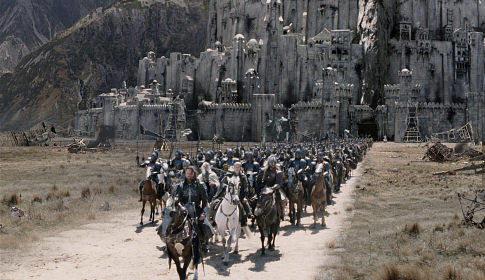
Much internet bandwidth has been devoted to arguing the relative merits between Lord of the Rings and that other epic fantasy film trilogy George Lucas’ Star Wars. It’s a silly debate really, because at their heart they’re very similar in structure. Both Tolkien and Lucas were striving to create new mythologies. Both heroes are engaged in life altering quests. Both contain great battles on which hangs the fate of their respective worlds. Both heroes believe in the possible redemption of an evil character. The big difference is the backgrounds of the two creators. Lucas, growing up in the 60s was clearly influenced by the pulp magazines and movie serials of the 1930s and 40s. Tolkien was influenced by his background in academia. To compare them on their merits as stories is rather a waste of time. Cinematically, though, the edge would belong to The Lord of the Rings, as Return of the King is a much sounder film than Return of the Jedi.
Return of the King is already starting appear at the top of many critics “Best of the year” lists which has lead to the inevitable Academy Award speculation. But if the film does happen to go unrecognized at Oscar time this coming March, it’s ok. The three films Peter Jackson has produced are a monumental achievement in film making that will stand unrivaled for sometime to come.