|
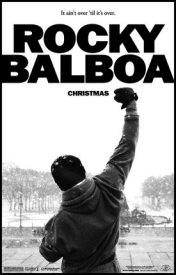
Rocky Balboa Reviewed By Rich Drees
With Rocky Balboa, we check in once again on the life of the cinematic boxer to find that he feels that life has maybe passed him by. Stallone has sketched a complex character for the fighter, far away from the two-dimensional caricature that Rocky had become towards the end of the original series of films. Revealed onion-like over the course of the film’s opening act, we find that to those around him, Rocky is the amiable ex-champ who is a local South Philly celebrity, signing the occasional autograph and reliving his glory days for his restaurant’s patrons. But inside, he is still hurting from his wife’s death a few years earlier, annually making a tour of the Philadelphia locations where they first courted. He finds no solace in his relationship with his son, who in trying to strike out on his own, has withdrawn from his father’s life almost completely. It’s this complex character that Stallone explores over the course of the film, making it more of a character study than a movie about boxing.
But it’s the boxing action that fans want to see and it’s a computer simulation of a fight between beating Rocky at his best beating the current heavyweight champion Mason “The Line” Dixon (Antonio Traver) that gets him back in the ring. Dixon’s showboating attitude has not won him many fans and his management hopes that a “friendly exhibition match” between the two would help to rehabilitate Dixon’s public image. Rocky, though, discovers that he still has something to prove to himself by stepping back into the ring.
Directorially, Stallone does an admirable job and is probably the best choice to helm this story. Much of the Philadelphia location work is shot lovingly, with even dilapidated South Philly row homes radiating a certain grandeur. And while the dramatics of the story are all handled well, it’s the climactic Las Vegas boxing match between Rocky and Dixon that the audience is there to see and which Stallone delivers in spades. He makes some interesting editorial choices - switching between color and black and white photography, and quick flashes of his past – help to give a dramatic weight to the bout and serve as a fitting summation of the entire Rocky series. |
 When it was first announced that Sylvester Stallone was planning on
making a new Rocky movie over 15 years after the last
installment of the franchise fizzled at the box office, many scoffed
at the notion of Stallone returning to the character that launched
his career. Perhaps blurring the line between the writer/actor and
his most famous character many felt that Stallone’s best days as an
actor were behind him and that attempting to mount a new Rocky
film at nearly 60 years old was a sad effort to hold on to his
fading glory. But much like his cinematic doppelganger, Stallone has
proven the naysayers wrong and leaves his audience cheering.
When it was first announced that Sylvester Stallone was planning on
making a new Rocky movie over 15 years after the last
installment of the franchise fizzled at the box office, many scoffed
at the notion of Stallone returning to the character that launched
his career. Perhaps blurring the line between the writer/actor and
his most famous character many felt that Stallone’s best days as an
actor were behind him and that attempting to mount a new Rocky
film at nearly 60 years old was a sad effort to hold on to his
fading glory. But much like his cinematic doppelganger, Stallone has
proven the naysayers wrong and leaves his audience cheering.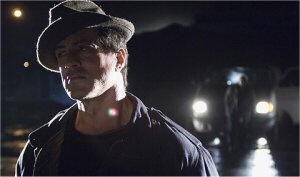 Rocky Balboa is a much more fitting bookend to the Rocky series
- both thematically and subtextually - than the last Rocky
movie, 1990’s tepid Rocky V. On one level Rocky Balboa
seems to be a meditation by Stallone on his own career. One can’t
help but wonder how much of the emotional material he imbues Rocky
with was drawn from real life, especially with his own son Sage
Stallone striking out on his own film career. Screenwriter Stallone
also gives some nice character moments to both Burt Young as his
brother-in-law Paulie and Tony Burton as Rocky’s trainer Duke, the
only actors from all five previous Rocky films to appear
here. There are several other nice nods to the original Rocky film
for fans of the series to discover, while boxing fans may notice a
few familiar faces making cameos.
Rocky Balboa is a much more fitting bookend to the Rocky series
- both thematically and subtextually - than the last Rocky
movie, 1990’s tepid Rocky V. On one level Rocky Balboa
seems to be a meditation by Stallone on his own career. One can’t
help but wonder how much of the emotional material he imbues Rocky
with was drawn from real life, especially with his own son Sage
Stallone striking out on his own film career. Screenwriter Stallone
also gives some nice character moments to both Burt Young as his
brother-in-law Paulie and Tony Burton as Rocky’s trainer Duke, the
only actors from all five previous Rocky films to appear
here. There are several other nice nods to the original Rocky film
for fans of the series to discover, while boxing fans may notice a
few familiar faces making cameos.