|
Serenity Reviewed by Rich Drees
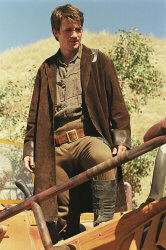
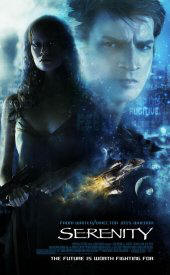
Malcolm Reynolds (Nathan Fillion) is an ex-soldier trying to eek out a living on the frontier of multi-habitable planet star system. Having been on the losing side of a planetary civil war – or “war of unification” as the winners, the utopian but totalitarian Alliance would have it – Reynolds bought a small space freighter and headed for the frontier, determined to leave “civilization” behind. Traveling between the planets with his crew – first mate and fellow war vet Zoe (Gina Torres), her husband Wash (Alan Tudyk), mercenary Jayne (Adam Baldwin) and engineer Kaylee (Jewel Staite) – Malcolm also harbors two fugitives from the Alliance, Simon (Sean Maher) and his sister River (Summer Glau), who had been experimented by Alliance doctors and apparently left not quite with all her faculties. The Alliance is desperate to get River back into their custody because locked in her head is a secret that could potentially unseat those in power and the crew soon finds itself in a race to get the information broadcast to the general populace before being killed by an Operative (Chiwetel Ejiofor) of the Alliance’s Parliament.
Although writer/director Joss Whedon would probably deny it, the plot of Serenity could very well be an allegory for how the story of the crew of the spaceship Serenity came to the silver screen. Cancelled after 11 of its produced 13 episodes had aired out of their intended order, Serenity’s progenitor television series Firefly found new life on DVD, selling over 200,000 units. Many of the sets were purchased by fans of the series, intent on passing them to the uninitiated, getting the word out on a show that they felt was underserved by its network. Impressed with that kind of fan loyalty, Universal Studios greenlit a big screen follow-up, Serenity.
Those
not familiar with Serenity’s televisual forbearer need not worry
about too much about feeling like they’ve walked into the middle of an
ongoing story. Whedon does a good job setting up the characters, their
situation and the universe they inhabit in two opening sequences that,
while dumping much exposition on the viewer, does so in a manner that
actively sets up the plot of the film.
While there are plenty of science-fiction thrills, Serenity is definitely a western with spaceships replacing horses and covered wagons. Malcolm is the disaffected soldier who finds the comfort he found living in the frontier endangered by the encroachment of civilization. He may be a thief, but he lives by a code of honor that doesn’t allow him to steal from other settlers. He knows that the best thing to do to keep his crew safe would be to abandon River and Simon to be found by the Alliance, but it wouldn’t be the right thing to do. On the other hand, doing the right thing would put his crew in almost certainly fatal peril.
Whedon’s script is dense and moves the plot along briskly, spanning many planets and juggling a dozen major and supporting characters. He also knows how to balance light-hearted character moments with dark action sequences, effectively making the audience feel that these characters are in mortal danger much more so than the heroes of your average science-fiction action flick. Whedon as a first-time feature director – he has helmed episodes of his Buffy, The Vampire Slayer and Angel television series - handles the transition to the big screen well, with only a two or three shots looking as if they were designed more for television than a cinema screen. But whatever its minor shortcomings, following a summer of loud, effects-laden, over-budgeted and ultimately hollow blockbusters, Serenity, with its cast of engaging and complex lead characters manages to be a science-fiction film that is actually about something. And that’s refreshing. |
 The parallels between the settlement of the Old West and the future
colonization of space is such a similar concept that it is a bit
surprising that, outside of a few Japanese animated series and the 1981
Sean Connery movie Outland, it hasn’t been explored more in popular
entertainment. To be sure, when Star Trek creator Gene Roddenberry
first pitched the original television series that would eventually launch
that long running franchise, he evoked a Western motif when he described
the show to network execs as Wagon Train To The Stars. But even
then, Roddenberry’s final frontier was too shiny and utopian. This brings
us to Serenity, a movie that, even without the obvious wardrobe and
production design visual clues, owes as much to the western as it does to
science-fiction.
The parallels between the settlement of the Old West and the future
colonization of space is such a similar concept that it is a bit
surprising that, outside of a few Japanese animated series and the 1981
Sean Connery movie Outland, it hasn’t been explored more in popular
entertainment. To be sure, when Star Trek creator Gene Roddenberry
first pitched the original television series that would eventually launch
that long running franchise, he evoked a Western motif when he described
the show to network execs as Wagon Train To The Stars. But even
then, Roddenberry’s final frontier was too shiny and utopian. This brings
us to Serenity, a movie that, even without the obvious wardrobe and
production design visual clues, owes as much to the western as it does to
science-fiction.