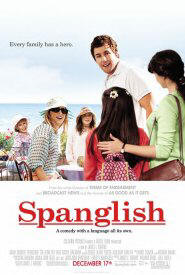
Spanglish
Reviewed by John Gibbon
 It seems that Hollywood of today continually touches the public interest
with flaccid action adventures and lifeless horror film recreations. Sadly,
films emulating true human conditions are often deemed as low budget indie
fodder. But one man seems to have a knack for finding the pulse of human
frailty, exposing it to his audiences with realistic and robust precision.
Director James L. Brooks had done it expertly in his previous work – 1983’s
Terms of Endearment and 1997’s As Good As It Gets are two
examples- and has managed to do it again with Spanglish.
It seems that Hollywood of today continually touches the public interest
with flaccid action adventures and lifeless horror film recreations. Sadly,
films emulating true human conditions are often deemed as low budget indie
fodder. But one man seems to have a knack for finding the pulse of human
frailty, exposing it to his audiences with realistic and robust precision.
Director James L. Brooks had done it expertly in his previous work – 1983’s
Terms of Endearment and 1997’s As Good As It Gets are two
examples- and has managed to do it again with Spanglish.
The story tracks the immigrant experience of a Mexican mother, Flor (Spanish star Paz Vega, Talk to Her), and her daughter Cristina (Shelbie Bruce). Flor has accepted to take a house-cleaning for the Clasky’s, the perfect example of upper-class white suburbia. She tries ever so hard not to become emotionally entangled in the family affairs, but quickly discovers that it’s a losing battle. She has no choice but to interact with the waspish Deborah, the soft-spoken but modest John who loves his wife and kids but has difficulties dealing with his newfound “super chef stardom”, Evelyn, the alcoholic grandmother who constantly recounts her Connie Francis-like glory days, and the two children who buzz in and out of the family awareness radar. Obviously matters get more than just a little complicated as the two families get more involved in each other’s lives.
Deborah (Tea Leoni) just can’t seem to get the whole idea of family life, ignoring her two kids and ridiculing John’s (Adam Sandler) parenting skills. Then she has the audacity to ‘kidnap’ Flor’s daughter for a day in town, while her own daughter, Bernie (Sarah Steele) is struggling with school, her weight, and her mother’s acceptance. Cristina respects Deborah as “the greatest white woman” she ever met, and so there is an invisible rift that widens between Flor and Deborah over how the girl’s need to be raised. Meanwhile John feels that he is unintentionally losing everything, yet his bonds with Bernie and Flor grow stronger. He continues to try and keep peace while quietly entranced by Flor’s beauty and heartfelt understanding.
There are some priceless moments throughout the film, such as an argument between John and Flor, speaking in English and Spanish respectively, while Flor’s fully bilingual daughter Cristina not only translates but adopts the exact gestures of the arguing duo.
Just as he did with Debra Winger in Terms of Endearment, and again
with Greg Kinnear in As Good As It Gets, Brooks possesses a genius
ability to persuade the best from his cast members. Leoni delivers such a
pivotal performance as she exhibits all of Deborah’s over-the-top manic
neuroses and mixed frustrations with resounding allure. Audiences will
quickly learn to hate Deborah, wincing at her own unrealized vindictiveness
and yet will feel honest pity for her lack of total common decency.
Deborah’s that lost soul that inspires one to want to slap her upside her
head and scream “Wake Up!”.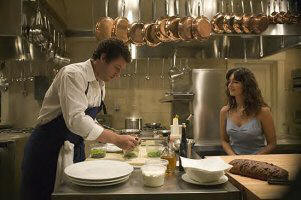
Spanish actress Paz Vega delivers a radiant performance for her American film debut that both enchanting and inspiring. She captures our hearts in the way she can present her emotions onscreen although she may say very little that we understand. Mary Tyler Moore Show alum Cloris Leachman, who plays Deborah’s mother, is an absolute joy to watch whether she is tugging her wine glass or dispensing good advice. Simply enveloping wit and charm, Steele is so damned lovable as Bernie and a few hearts will break for her realistic portrayal.
Brooks had once succeeded in creating believable feminist heroes, like Winger’s Emma or even Holly Hunter’s Jane from Broadcast News (1987). However, times are different now and real-life men who work and are serious fathers now play a heroic part in his films. So, Adam Sandler (playing the super-passive, nice-guy husband, John) proves again that he can deliver a sincere dramatic role with distinct clarity, much like he did in the brilliant Punch Drunk Love (2002). Sure, some of his trademark loveable dopiness rises to the surface, but he succeeds in capturing the emotions of a sympathetic, loving guy who is a devoted husband and father.
Spanglish
is a very
human,
profound and amusing film that draws few laughs and a little more tears.
It’s a heartfelt social commentary on life disguised in a deeply fulfilling
movie about barriers – language, cultural, marital, values, love and most of
all, the ones we place in ourselves.
The movie
also succeeds through a
well written story
that at times drags a little, but nonetheless intelligently leaves
story threads untied as nothing is clearly cinched, leaving the audience to
draw some of their conclusions. Again Brooks makes a compelling story about
people that matter. And that should be as good as it gets.