|
Three… Extremes Reviewed By Rich Drees
Leading off the triptych is Dumplings, perhaps the most chilling of the three stories, an effect born out of the almost casual air of the two leads as they go about their gruesome business. Ching (Miriam Yeung) is a former actress approaching middle-age and looking to make sure that her husband remains interested in her. To that end she is directed to Mei (Bai Ling) whose homemade dumplings contain a special ingredient which will purportedly help her retain her youthful looks. The secret ingredient in the dumplings is a plot point not to be divulged here, as it is the crux upon which the whole segment derives its impact (Some sterling sound design work also helps to get the skin crawling). However, the reveal of the secret ingredient is only the beginning. Director Fruit Chan carries the premise unflinchingly to its grisly conclusion, with the horror of the situation amplified by the character’s utterly blasé attitude to the proceedings.
The middle segment sees Korean director Chan Woo Park (Oldboy)
continuing his exploration of the concept of revenge with Cut,
the story of a film director who has been taken hostage by a crazed
film extra. The director has become rich and successful while still
remaining a kind and thoughtful man. The extra wants the director to
confront the fact that he has the capacity to commit evil within him
by giving him an ultimatum- strangle a bound and gagged child or the
extra will begin to cut off the fingers of the director’s pianist
wife. What follows is a grueling mental and physical torture for all
involved, with an ending as unresolved as the final chords of the
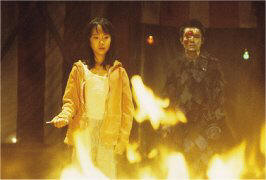
segment’s piano-based soundtrack. The final story, Box, from the stylistic Japanese director Takishi Miike, is a film that is more tone poem than narrative. A young woman novelist is haunted by a recurring nightmare. In the dream, two young girls are part of their magician-father’s stage act, contorting themselves into small boxes which are then opened to reveal an explosion of flowers. However, one of the girls is definitely more favored by their father than the other, whose jealousy turns murderous. While the writer struggles with the nightmares, the audience is forced to wonder if they are merely bad dreams or guilty memories. The only strong negative to the anthology is that the film’s American distributor, Lion’s Gate Films, has apparently reordered the three segments from their original Asian release. When the film was released overseas, Box was first, followed by Dumplings, with Cut closing out the movie. This rearrangement harms the overall impact of the film as the ending of Box, which almost feels as if it were a Twilight Zone episode directed by David Lynch, is not as strong as the finale of Cut, allowing the picture to end on not quite as loud and unsettling a bang as it can. Still, all three short films are strong, yet stylistically distinct enough to stand on their own (Indeed, Chan has expanded and re-shot Dumplings as a feature length film). Yet for all their individuality, they are united by the theme that horror doesn’t necessarily come from some supernatural element but from the extremes in human behavior. |
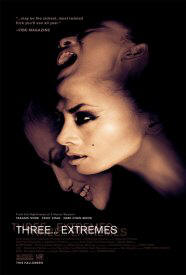 Perhaps in an effort to show that the current wave of Asian horror
films aren’t all just spooky ghost children, Three . . . Extremes,
an anthology film teaming a trio of the Pacific Rim’s most
prominent directors, proves that it isn’t necessary to splash
copious amounts of fake blood around to give an audience a good
scare.
Perhaps in an effort to show that the current wave of Asian horror
films aren’t all just spooky ghost children, Three . . . Extremes,
an anthology film teaming a trio of the Pacific Rim’s most
prominent directors, proves that it isn’t necessary to splash
copious amounts of fake blood around to give an audience a good
scare.