The Triplets of Belleville
Reviewed By Rich Drees
 The Triplets of Belleville
is a work of singular vision and beauty. More so than other traditionally
two dimensionally animated films of recent vintage, Triplets creates
its own fascinating and unique world that draws in its viewers with its
complexity and imagination.
The Triplets of Belleville
is a work of singular vision and beauty. More so than other traditionally
two dimensionally animated films of recent vintage, Triplets creates
its own fascinating and unique world that draws in its viewers with its
complexity and imagination.
Champion is a young French boy who lives a lonely life with his grandmother, Madame Souza. The only token he has of his parents is a faded picture of them on a bicycle. Given a gift of a bicycle, and perhaps inspired by the photo, Champion spends his formative years training for the Tour de France. But when he finally enters the race, he is mysteriously kidnapped by French gangsters and taken over the ocean to the city of Belleville, an ersatz Manhattan. His grandmother follows the gangsters to Bellville where she meets the Triplets, three old nightclub singers who were the toast of the town in their youth. Together the four hatch a plan to rescue Champion.
The story of Triplets may be slight and without many twists, but that’s not the point. It’s the flair with which the story is told that makes this film compelling and entertaining. There is more artistry in any random frame of The Triplets of Belleville than any traditionally animated film of recent memory and that is what makes the film so refreshing and a joy to watch.
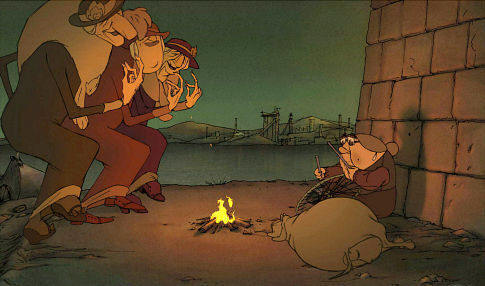 Though the opening scene showing the triplets night club act in their Jazz
Age heyday definitely has the loose, rubbery-limbed feel of pioneer
animators Max Fleischer or Ub Iwerks, the bulk of the film sports its own
unique look. The character designs are rich and expressive, from the
symmetry of the mobsters to all the residents of Belleville being
overweight. (A jab at American consumerism, perhaps?) Physical
characteristics are strangely distorted without becoming grotesque, whether
it be the grandmother’s leg that is shorter than the other, Champion’s
overdeveloped leg muscles or rubber-spined Matre’d.
Though the opening scene showing the triplets night club act in their Jazz
Age heyday definitely has the loose, rubbery-limbed feel of pioneer
animators Max Fleischer or Ub Iwerks, the bulk of the film sports its own
unique look. The character designs are rich and expressive, from the
symmetry of the mobsters to all the residents of Belleville being
overweight. (A jab at American consumerism, perhaps?) Physical
characteristics are strangely distorted without becoming grotesque, whether
it be the grandmother’s leg that is shorter than the other, Champion’s
overdeveloped leg muscles or rubber-spined Matre’d.
But Triplets isn’t all style and no substance. The film uses virtually no dialog, but still manages to tell its story effectively. One five-minute segment early in the film depicts Champion’s training with his grandmother as coach. This wordless sequence communicates more about these two characters and their relationship than many American animated films do over their entire running time. It’s a nifty trick executed well and in some ways recalls the techniques used during the days of silent film.