|
Walk The Line Reviewed by Rich Drees
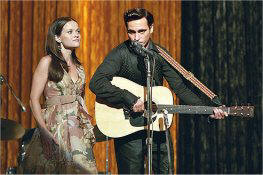
Based on Cash’s two volumes of autobiography, Man In Black and Cash, An Autobiography, Walk The Line chronicles the singer’s early life and career, examining the things that drove Cash to pursue success as a singer. Growing up on his parents' cotton farm in rural Arkansas, Cash could never get the approval of his alcoholic and emotionally and infrequently physically abusive father (played by Robert Patrick with a cold, sadistic intensity not seen since his role as a killer robot in Terminator 2 (1991). When his older brother dies in an accident, Cash is told by his father that “God took the wrong son.” Escaping home as early as possible and perhaps looking to dispel his father’s disapproval, Cash (Joaquin Phoenix) enrolls in the Army and marries a girl, Vivian (Ginnifer Goodwin), whom he had only spent a few weeks courting. However, their marriage will be a troubled one as Vivian will never be supportive of Cash’s burgeoning musical career, forcing Cash to look for emotional support elsewhere, ultimately in the form of country/gospel singer June Carter (Reese Witherspoon in a performance much better than one would expect given her lightweight romantic comedy background). It is almost
impossible not to be tempted to draw comparisons between Walk The
Line and last winter’s Ray Charles bio-pic, Ray. Both
musicians grew up in the poverty-stricken south. Both suffered
through the childhood death of a sibling, events that would fuel
their drive for success. And, of course, both musicians were at the
center of two of the influences that would merge to form rock and
roll- Charles with soul and rhythm and blues and Cash with country
and rockabilly. The parallelisms in their stories almost seem to
suggest that when it came to success in the early days of rock and
roll, everything but the song remained the same (to mis-appropriate
a phrase from another legendary rock icon). However, where the similarity between the two films ends is how each film’s lead approaches to his role. Where Jaimie Fox went for (a successful) straight impersonation of Charles, Joaquin Phoenix strives more to convey Cash’s emotional state than his vocal mannerisms. Phoenix does have an approximation of Cash’s rough-edged Southern drawl, but it never sounds as though he’s purposefully attempting an impersonation and not hitting the mark. Further helping Phoenix’s portrayal of Cash is that he, unlike Foxx who merely lip-synched to Charles’ hits, supplies his own vocals (as does Reese Witherspoon) for the concert scenes, avoiding the slight moments of disconnect in Ray when Jamie Fox ceased speaking and the Ray Charles recording began. Like all other bio-pics, Walk The Line has its moments where the facts come secondary to the necessities of cinematic storytelling. While Cash’s brother actually clung to life for almost a week following his accident, having him die the same day helps to amplify the sudden, cold cruelty of it all, as well as to strengthen the anger that Cash’s father lashes out with towards the rest of the family. The film also ignores two important incidents that spurred Cash to kick his drug habit: the deaths of his long-time guitarist Luther Perkins and two of close friend Roy Orbison’s sons in separate house fires. Instead, the film focuses on a breakdown over a Thanksgiving dinner between Cash and his parents and June Carter’s parents and children. These changes, as well as leaving out the fact that Carter wrote the song “Ring of Fire” (which dealt with her conflicting emotions of her relationship with Cash) in collaboration with Merle Kilgore, are forgivable, as they merely strengthen the storyline of Cash and Carter’s love affair. |
 Johnny Cash has become such an icon of American 20th
century music that even those who have never heard a note of his
singing could probably tell you who the “Man in Black” was. But
behind the image was a man driven by some very personal demons,
hoping that success would exorcise them. It’s this man that we are
introduced to in Walk The Line.
Johnny Cash has become such an icon of American 20th
century music that even those who have never heard a note of his
singing could probably tell you who the “Man in Black” was. But
behind the image was a man driven by some very personal demons,
hoping that success would exorcise them. It’s this man that we are
introduced to in Walk The Line.