War Of The Worlds
Reviewed by Rich Drees
 Early in his career, with such films as Close Encounters Of The
Third Kind (1977) and E.T.: The Extra-Terrestrial (1982)
to his credit, director Steven Spielberg stated that he wasn’t
interested in making films where visitors from outer space where the
bad guys, aliens bent on invasion and destruction. Somewhere along
the way, he has changed his mind, bringing us an adaptation of one
of the first and still best tales of space invaders- H. G. Wells’s
War Of The Worlds.
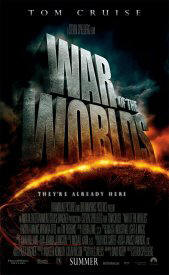
Early in his career, with such films as Close Encounters Of The
Third Kind (1977) and E.T.: The Extra-Terrestrial (1982)
to his credit, director Steven Spielberg stated that he wasn’t
interested in making films where visitors from outer space where the
bad guys, aliens bent on invasion and destruction. Somewhere along
the way, he has changed his mind, bringing us an adaptation of one
of the first and still best tales of space invaders- H. G. Wells’s
War Of The Worlds.
For those who are familiar with the original H. G. Wells novel, there aren’t many narrative surprises. With just a few tweaks – the most obvious being the reimaging of the central character as a divorced father of two – Wells’s novel has been faithfully and surprisingly successfully translated to modern times. The major plot elements from the book are all here: the tripods’ methods of attacks, the ferry and farmhouse basement scenes, the trek across the countryside, the Red Weed. All are remarkably brought to life by director Steven Spielberg and his crews of productions designers, set and prop builders and visual effects technicians. Unfortunately, the film, like the novel, ends on more of a whimper, following the bang that was the preceeding hour and forty-five minutes. Spielberg tries to end things on an emotional high point, but like many of the survivors glimpsed throughout the film, we’re a little too shell shocked for it to register fully.
By sticking to the original novel’s basic premise - one survivor of an alien invasion attempting to make his way across country to safety - the film eschews many of the convents of summer blockbusters. There are no thrilling clashes between an outgunned military and the technologically overwhelming aliens, where the maverick hotshot soldier/pilot defies the odds and makes the one-in-a-million shot needed to repel the invaders, all the while rousing music blares on the soundtrack. The few times the military is seen is when they are on their way to confront the invaders and the mood is one of grim fatalism. There are no presidents making stirring speeches in the midst of this invasion. The whole story is seen through the eyes of survivors on the ground, trying to sort out facts from rumors so they can find their way to safety.
 Forgetting for a moment - if that is indeed possible - his tabloid
hijinx, Tom Cruise has delivered a very credible performance of an
average Joe trying to put on a brave face in front of his children
while having no idea of what to do except keep running. His
character isn’t a great person- he’s an arrogant, blue-collar guy
who never really grew up. It’s easy to see why his wife divorced
him. This is not the typical Cruise movie star role, where he can
coast on his perfect smile and charm. This is much more of an
actor’s role, with Cruise giving perhaps his strongest performance
since Magnolia (1999).
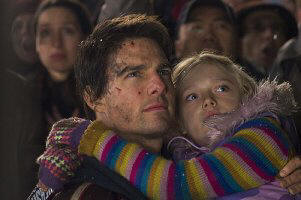
Forgetting for a moment - if that is indeed possible - his tabloid
hijinx, Tom Cruise has delivered a very credible performance of an
average Joe trying to put on a brave face in front of his children
while having no idea of what to do except keep running. His
character isn’t a great person- he’s an arrogant, blue-collar guy
who never really grew up. It’s easy to see why his wife divorced
him. This is not the typical Cruise movie star role, where he can
coast on his perfect smile and charm. This is much more of an
actor’s role, with Cruise giving perhaps his strongest performance
since Magnolia (1999).
But as good as Cruise is, the true standout performance is from 11 year old Dakota Fanning as Ray’s daughter Rachel. The script demands some strong emotional moments, oft times just played through facial expression that would challenge seasoned adult actors, yet Fanning delivers them flawlessly.
Visually, the film is a marvel. Spielberg knows how to create visual set pieces, and he is working at the height of his talent here. Ray’s witnessing of the emergence of a tripod in his neighborhood and his mad dash back home to his children is a taut, thrilling segment that is only the opening salvo of an extended sequence of Ray and his children’s panicked flight from the alien invaders that encompasses the film’s first third. But these aren’t thrills like the ones Spielberg delivered in movies like Raiders Of The Lost Ark (1981). This film has a much darker tone, which is a reflection of the darker times of the current clime. However, Spielberg leaves the viewer to find their own interpretation of the story (Recall that the original novel was written by Wells in part as a criticism of British colonialism.). Is this film an allegory for many people’s current fear of domestic terrorist attack? Is it a reflection on how the populace of a foreign country might see the mechanized superiority of our own country’s military? Arguments can be made for both points of view, which just may be one reason Spielberg decided to bring this story to the big screen.