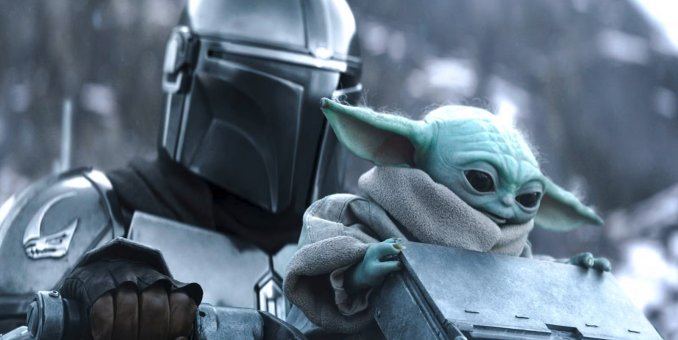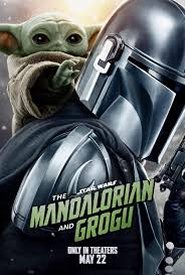
How much one enjoys the new Star Wars film, The Mandalorian And Grogu, could depend on where one sets their expectations. If you think that the first new installment of the blockbuster franchise in seven years should be a big event in terms of storytelling and impact, then one might be underwhelmed. But if one is looking for a fun adventure story featuring the franchise’s two biggest characters to come out of the Disney+ streaming TV side but without the baggage of needing to know seasons of TV lore, then one will probably find the film an enjoyable way to pass two hours in a theater as the summer blockbuster season of 2026 kicks off.
So what does one need to know going into The Mandalorian And Grogu? Just that the armored and mysterious Mandalorian (voiced and played by Pedro Pascal when his helmet is off) and his ward, the Force-sensitive alien child Grogu, are helping the New Republic track down Imperial war criminals still on the run a few years after the Galactic Civil War that made up the original Star Wars trilogy. The New Republic, represented here by Sigourney Weaver, assign the duo to go rescue the missing nephew of two crime bosses in an area outside of New Republic jurisdiction in exchange for the whereabouts of a particularly wanted Imperial warlord. Of course, the mission doesn’t go as planned and the pair are on their way, planet-hopping across the galaxy, trying to survive reversals of fortune while they hunt their quarry.
And that’s pretty much it. Their adventure doesn’t have galactic ramifications. Nor does it dramatically change their lives or relationship. There are no plotlines left hanging to be picked up in other media. (Although this is Star Wars, which guarantees that virtually even the most minor of incidental characters will spark some new story i the extended media of comics and books.)
As a one-off adventure of the titular pair, no major knowledge investment of the series needed. The movie opens with a few lines of text to conceptualize where the story is set in the overall Star Wars cannon, but that’s it really. That is not to say that the film is entirely devoid of references to other elements of the Star Wars galaxy. Diehard fans will have fun picking out background details and references, and I am sure that some enterprising YouTuber is already at work on a video detailing all the different, previously seen `droid types that have been cannibalized and mashed together to form the members of a certain crime boss’s personal guard and army.
Is the film part of the bigger overall storyline being told in some of the Disney+ streaming shows set in this ear of the Star Wars timeline? Not particularly and that’s just fine. It is possible that the rise of interconnected film franchises that continually build to bigger moments have trained audiences to expect that every film should “matter,” and be in service to a larger story being told. But sometimes, it is okay to just tell a fun story that exists to just be a fun story.
(That’s not to say that I think interconnected franchises are inherently a bad thing. Done correctly, they build audience investment in deeper defined characters and can ultimately lead to such iconic, viral payoff moments as when Captain American lifts Thor’s hammer in The Avengers: Endgame. They just don’t need to be the only type of storytelling going on in a franchise.)
And while the story of The Mandalorian And Grogu may not oush the overall Star Wars forward in a perceivable way, the film’s score courtesy of compose Ludwig Goransson, certainly charts into new territory for the franchise. A good portion of Star Wars score not written by the fantastic John Williams at least drew on his European-influenced orchestral motifs. When he was chosen to score The Mandalorian streaming show, Goransson used a different template, bringing in other cultural influences. The result was music that still felt like Star Wars in its own way, yet different enough make the new series stand on its own. Goransson doesn’t rest on his laurels for the film, as he brings such diverse elements as hip-hop and electronica to Django Reinhardt-sounding early New Orleans jazz to the musicscape of that galaxy far, far away.
Star Wars has always been in part a product of the influences of its makers. The original trilogy definitely drew inspiration from the Saturday matinee cliffhanger series of the 1930s and `40s, as well as George Lucas’s own love of cars. Here, the films of the 1970s and `80s can be seen peeking out around the edges of the movie. Some landspeeders featured in one of the film’s chase sequences look like futuristic versions of the Tucker Tornado car automobile in Coppola’s biopic Tucker: The Man And His Dream. One action sequence early on opens with a moment that feels lifted from Brian DePalma’s Scarface while a chase sequence later in the film echoes the elevated train chase from The French Connection, except here a baby pram is part of the action and not an obstacle.
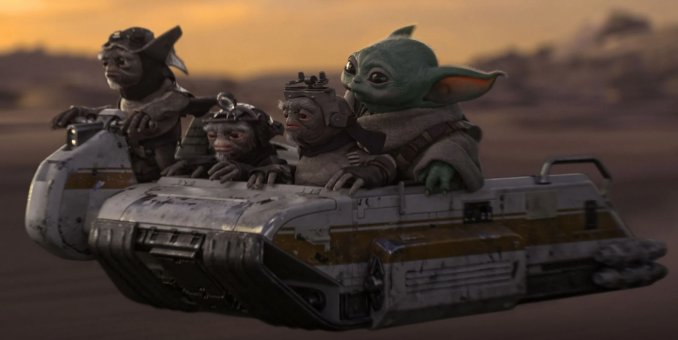
Although it goes back to the beginning of The Mandalorian, the decision to make Grogu primarily a practical puppet and not a computer-animated creation is one that continues to payoff. Not only does having a physical puppet on screen intuitively feels right when you look at it, there is also a certain charm that has helped put the character over. The filmmakers here, extend that to the diminutive alien starship mechanics, the Anzellana. While the sequences that pair them together slows down the film a bit, there is fun to be had in them.