I have to admit, while I am a lifelong fan of the classic Warner Brothers animated shorts, I never really connected with the ones with Wile E Coyote and the Road Runner. The shorts just felt like one joke being told over and over. Admittedly, they were told skillfully and with plenty of funny variations, but they never really connected with me. But Coyote Vs Acme takes how Wylie continually submits himself to that one joke premise and made it the cornerstone on which the equally parts hilarious and heartfelt Coyote Vs Acme has been built. The result is a film that is without a doubt the best animation-live action hybrid since 1988’s Who Framed Roger Rabbit?.
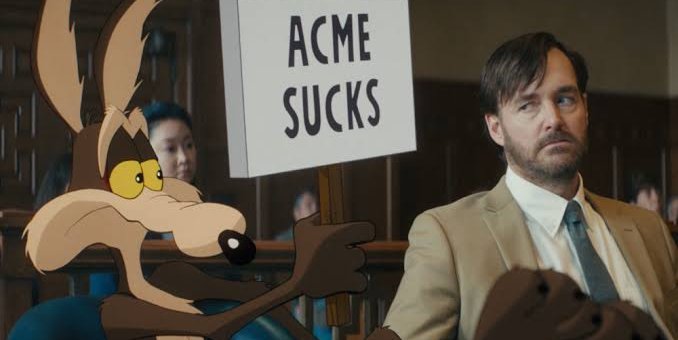
Wile E Coyote (Hungrious carnivorus) has been trying to catch the Road Runner (Fastas Helus) for some time now, but every one of his attempts have all met the same end – disaster due to a faulty product from Acme Corporation, a corporation with the motto “A company with family values that values its family… of companies.” But after one particularly Rube Goldberg-ian failure, Wile sees an ad for an attorney, Kevin Avery (Will Forte), who specializes in small cartoon-related claims against Acme. However, Wile manages to trick Kevin into filing a much larger lawsuit, for a much bigger potential payday. Can Kevin and his associates pull together a case that can beat the Goliath legal department of Acme?
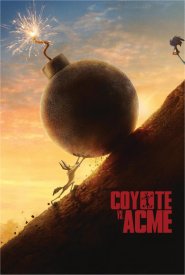
At its core, Coyote Vs Acme is cross between a David-and-Goliath story and the Greek legend of Sisyphus, who had been fated to roll a large rock up a hill, only for it to roll back down before he could get it to the top. The Coyote tries on what seems to be a daily basis to catch the Road Runner, only to have every plan he comes up with to do so blow up – often literally – in his face. And yet he keeps trying. He doesn’t resort to ordering take out pizza or getting a meal through Door Dash.
Keeping true to its Looney Tunes animated shorts of the 1930s through the `50s, Coyote Vs Acme has plenty of fun and frantic set pieces that feel apiece with their inspiration. And the film has some fun by applying cartoon physics to the real world. But director Dave Green also knows when to slow things down and to let Kevin and Wile build their relationship. And that relationship is really the heart of the film, with Kevin slowly coming to see Wile not as a troublesome client, but as an inspiration. The film’s third act involving some sort of Congressional hearing-cum-trial doesn’t make a whole lot of sense and may be a bit slow for some kids, but it pays off the whole story’s emotional core in a satisfying way.
Needless to say, the circumstances surrounding the film’s certainly resonate with the movie’s central theme. Originally set for a 2024 release – in the weekend Warners would eventually slot Great Gerwig’s Barbie into, creating the cultural zeitgeist “Barbenheimer” moment – the studio bounced the film around on its release schedule a few times before making the announcement that they were looking to just shelve it and take a tax write off. Outcry from animation fans who had already watched the studio vault a number of animation projects mid-production (as well as a live action Batgirl movie) led to petitions and social media campaigns calling for the film’s release. Eventually distributor Ketchup Entertainment stepped up and bought the film outright, finally getting it into theaters today. And it does feel as if fans won a battle against a corporate giant. The film is available to be seen, and it is certainly of a quality that far exceeds it being fated to disappearing down a corporate black hole. And that is really the ultimate win.