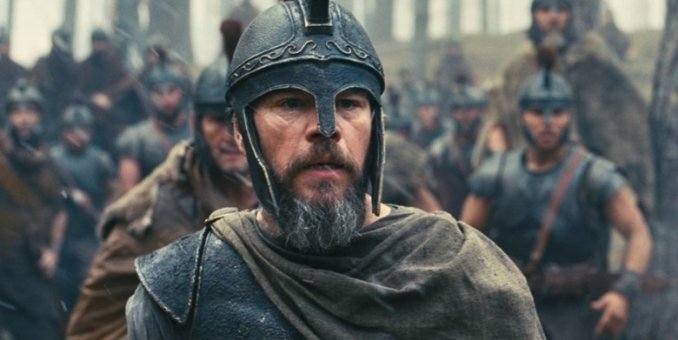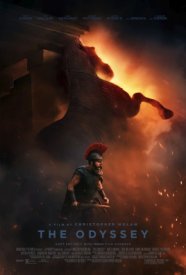
Homer’s epic poem The Odyssey has been the foundation of much of storytelling tradition that has followed. It has been told and retold, translated and reexamined in numerous different ways. Director Christopher Nolan is not the first to have approached the material with the intention of finding new ways to illuminate these old legends. Taking place, as an onscreen title tells us as the film opens, in “a time of apparent magic,” Nolan’s adaptation of The Odyssey is a tale of high adventure, palace intrigue, the fallibility of heroes and the toll war can take on a man’s psyche. It is also the director working at the height of his skills and turning in one of the best films of his career.
Nolan has a penchant for telling his stories in a non-linear fashion, and he does so here as well. The film opens with Odysseus (Matt Damon) having left for war twenty years earlier. Others who had left with him have long since returned and there is pressure for his wife Penelope (Anne Hathaway) to take on a new husband to rule over Ithica. Odysseus’s son Telemachus (Tom Holland) journeys out to find word of his father, while a group of Penelope’s suitors (led by a rather sniveling Robert Pattinson) plot his death. Meanwhile, Odysseus has been living on an island with the nymph Calypso (Charlize Theron), who feeds him lotus flowers to keep him amnesic and not wanting to journey home. The story unfolds in part as Odysseus regains his memory and as Telemachus gathers news and stories of what could have happened to his father. As such, some of these stories may be exaggerated in their retelling. It makes an interesting meta-textual nod to the original source material’s origins in oral and literary traditions. This also creates a parallel between father and son as they each learn part of the story. That helps create their connection when they finally are reunited at the start of the film’s final act.
Most filmmakers who have dealt with Greek myths have concentrated on the big spectacle that those stories supply. Monsters and swords and sandals swashbuckling tend to make for some Saturday matinee thrills. But Nolan is not necessarily interested in that, though he doesn’t necessarily shy away from some of those moments in the narrative either. We see the epic sweep of battle as the Greeks as they finally make it past the gates and into the city of Troy. But their scope only serves to ultimately illustrate the film’s much more grounded approach to these epic stories. The inside of the Trojan Horse is cramped and terrifying. Magic is not depicted with bright beams of light emanating from someone’s hand but instead has a much more tactile representation. Circe’s transformation of the soldiers into pigs is very much a hands-on experience. It is a moment that borders on body horror, and recalls the transformations in John Landis’s An American Werewolf In London. Nolan accentuates the moment by moving his camera and only giving us glimpses of what is happening, our view being obscured by characters or objects within Circe’s hut.
Interestingly enough, The Odyssey seems very much in conversation with Nolan’s previous film, 2023’s Oppenheimer. In that film, J. Robert Oppenheimer, creator of the atomic bomb, had trouble confronting the knowledge of the enormity of his creation. In The Odyssey, Odysseus fully embraces responsibility for the deaths at the siege of Troy and the use of the Trojan horse. Viewed side-by-side, the contrast between the two characters makes for an interesting two-sided examination of the personal cost of being an architect of war.